
Every parent knows the moment: your child comes home upset about a playground argument, a birthday party snub, or a best friend who suddenly isn’t talking to them. Your instinct is to fix it — to call the other parent, mediate, or march into school. But knowing when to intervene in your child’s friendship drama versus when to let them navigate it themselves is one of the trickiest judgment calls in modern parenting. Step in too early and you rob them of critical social learning; wait too long and real harm can take root.
This framework offers a systematic way to assess friendship problems in children and decide your next move. It’s built around observable signals, not gut panic, and it’s designed to help you distinguish between normal developmental friction and situations that genuinely require adult intervention. Understanding when to intervene in your child’s friendship drama starts with recognizing that most peer conflict is actually part of healthy child development — the question is learning to spot the exceptions.
Parents often search for when to intervene in your child’s friendship drama because the line between helpful support and over-involvement feels surprisingly hard to see in real time.
The Severity-Duration-Capacity Matrix
Key Insight: Most parents assess friendship drama on severity alone, but the decision to intervene should weigh three independent variables: how severe the incident is, how long the pattern has persisted, and whether your child has the developmental capacity to resolve it.
A single high-severity incident (physical aggression, exclusion from a large group event) may warrant immediate intervention even if it’s the first time. But low-severity friction that persists for weeks can be equally damaging and often flies under the radar. Meanwhile, a six-year-old lacks the executive function and emotional vocabulary that a twelve-year-old has — so identical conflicts require different thresholds. This matrix prevents both over-functioning (helicopter rescues) and under-functioning (dismissing real distress as “kids will be kids”).
- Severity: Is this a minor squabble, a recurring exclusion pattern, or behavior that crosses into bullying or harm?
- Duration: Is this a one-off bad day, or has it been happening for weeks with no sign of resolution?
- Capacity: Does your child have the language, emotional regulation, and social skills to address this on their own?
- Convergence: When two or more variables spike simultaneously, intervention moves from optional to necessary.
Use this matrix as a triage tool every time you’re unsure whether to step in or step back when evaluating when to intervene in your child’s friendship drama.
Assess Severity: What Type of Conflict Are You Seeing?

Not all friendship problems in children carry the same weight. The first step in deciding when to intervene in your child’s friendship drama is to categorize the conflict type. Low-severity conflicts include one-time disagreements, hurt feelings over a game, brief exclusions, or miscommunications. These are the daily friction points of childhood social life and typically resolve on their own or with minimal coaching.
Moderate-severity conflicts involve repeated exclusion by a small group, name-calling that’s becoming a pattern, or situations where your child is visibly distressed but still functioning. According to Child Mind Institute’s overview of friends and socializing, these are the gray-zone conflicts where parents should monitor closely and offer coaching, but not yet intervene directly with other children or parents.
High-severity conflicts include physical aggression, targeted social exclusion campaigns, cyberbullying, threats, or any behavior that crosses into harassment. These require immediate adult intervention regardless of duration or your child’s coping capacity. If you’re seeing any of the following, don’t wait: hitting, kicking, or physical intimidation; coordinated exclusion by an entire peer group; online harassment or rumor-spreading; or threats of harm. These are non-negotiable intervention triggers when assessing when to intervene in your child’s friendship drama.
Measure Duration: Is This a Bad Day or a Pattern?

A single bad day is normal developmental noise. A pattern is a signal. When evaluating when to intervene in your child’s friendship drama, track how long the issue has been happening. If this is the first or second mention of a conflict, your default should be to coach, not intervene. Offer your child language, role-play responses, and check in tomorrow to see if it resolved naturally.
If the same conflict is mentioned three or more times over a two-week period, you’re looking at a pattern. Patterns indicate that your child’s current strategies aren’t working and that the other child (or group) isn’t self-correcting. This is the point where many parents still hesitate, worried about being “that parent” who overreacts. But research on fostering healthy friendships and social skills shows that unresolved peer conflict lasting more than two weeks begins to erode a child’s self-concept and willingness to engage socially.
At the two-week mark, escalate from passive coaching to active monitoring. Reach out to the teacher or school counselor to ask what they’re observing. Don’t accuse or demand action yet — frame it as information-gathering. Many friendship problems in children look different in the classroom than they do in your child’s retelling, and you need the full picture before deciding when to intervene in your child’s friendship drama with direct action.
Evaluate Your Child’s Developmental Capacity
A nine-year-old and a five-year-old experiencing the same exclusion incident require entirely different responses. Developmental capacity is the variable most parents underweight when deciding when to intervene in your child’s friendship drama. Younger children (ages 4-7) have limited emotional regulation, struggle to perspective-take, and lack the verbal skills to navigate nuanced social conflict. If your kindergartener is being left out at recess, they likely need you to intervene with the teacher because they can’t yet advocate for themselves effectively.
Middle childhood (ages 8-11) is the transition zone. Kids this age are building social problem-solving skills but still need scaffolding. They can often handle one-on-one conflicts with coaching, but group dynamics or sustained exclusion may overwhelm them. Your role here is to coach first, monitor second, and intervene only if their attempts fail. Offer specific scripts, role-play difficult conversations, and debrief what happened when they try a new strategy. This is covered in depth in our guide on building social skills post-pandemic.
Tweens and early teens (ages 12+) generally have the cognitive and emotional tools to manage most peer conflict — but they need to know you’re available as a backup. For this age group, intervening directly in friendship drama often backfires socially. Instead, focus on teaching them when and how to escalate to a trusted adult themselves. The exception: situations involving safety, mental health risk, or clear harassment. In those cases, intervene immediately regardless of age, and explain to your teen why you’re stepping in despite their protests.
Use the Decision Matrix to Choose Your Response Level
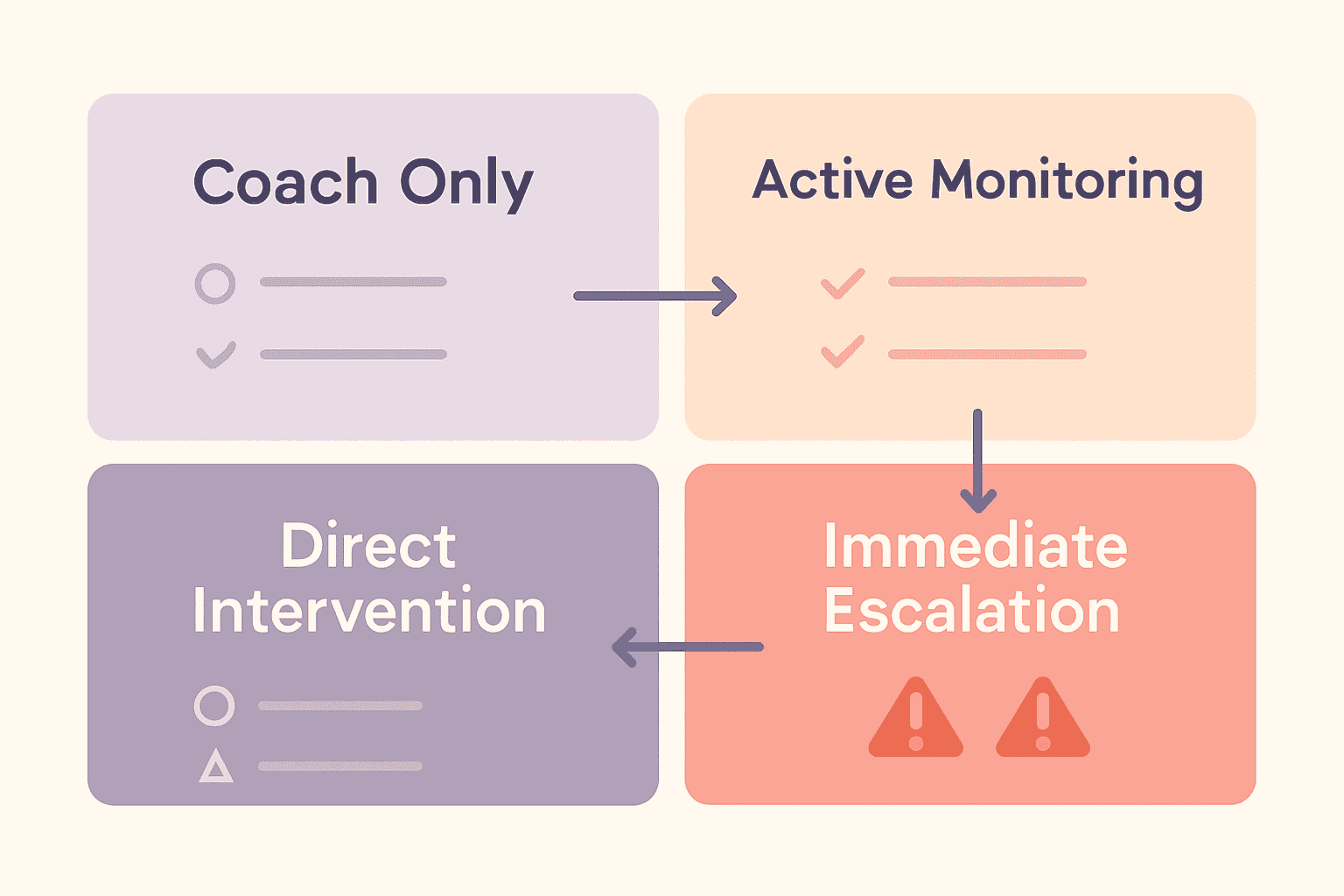
Now that you’ve assessed severity, duration, and capacity, plot them on a decision matrix to determine your response level. This is the operational core of the framework for when to intervene in your child’s friendship drama. Low severity + short duration + capable child = coaching only. Offer emotional validation, help them brainstorm responses, and check in the next day. Do not contact other parents, teachers, or children. This is the vast majority of childhood friendship problems in children and resolves within 48 hours.
Moderate severity + medium duration + capable child = active monitoring. Continue coaching, but now loop in the teacher or school counselor as an observer. Ask them to watch the dynamic and report back. You’re not asking for intervention yet, just data. If your child tries the strategies you’ve coached and the conflict persists or escalates, move to the next tier. This is the response level for situations described in resources like Hudson Valley Parent’s guide to the importance of friendship, where support structures matter but direct adult interference can hinder learning.
High severity OR extended duration OR incapable child = direct intervention. At this level, you contact the teacher, school counselor, or other parent (in that order of preference). Be specific, factual, and solution-oriented. Describe what your child has reported, what you’ve observed, and what you’re asking for (e.g., seating changes, recess monitoring, a mediated conversation). Avoid accusatory language and focus on your child’s experience, not the other child’s intent. This is the tier where most parents fear they’re overreacting — but if you’ve worked through the matrix honestly, you’re not.
Any situation involving physical harm, sustained harassment, or mental health distress = immediate escalation. Contact school administration, not just the classroom teacher. Document incidents with dates and details. If the school is unresponsive or the behavior continues, you may need to involve a pediatrician, therapist, or in extreme cases, law enforcement. This is rare, but when it’s warranted, speed matters. Delayed intervention in high-severity situations can have lasting emotional and psychological consequences, and no parent should hesitate when to intervene in your child’s friendship drama at this level.
Coach Your Child Through Low-Level Conflicts
For the majority of situations where you decide not to intervene directly, your job is to coach effectively. Coaching means giving your child the tools to solve the problem themselves, not solving it for them. Start by validating their feelings without judgment. “That sounds really frustrating” or “I can see why that hurt your feelings” signals that you’re listening and that their distress is real, even if the situation doesn’t require your intervention.
Next, help them reframe the conflict. Ask open-ended questions: “What do you think they were feeling when that happened?” or “Can you think of a reason they might have said that?” This builds perspective-taking skills and often de-escalates the emotional intensity. Many friendship problems in children stem from miscommunication or clumsy social attempts, not malice, and helping your child see that reduces the sting. Resources from helping your child through a friendship breakup offer additional language for these conversations.
Then offer specific, actionable strategies. “Tomorrow, you could try asking if you can join their game” or “If it happens again, you could say, ‘That hurt my feelings. Can we talk about it?'” Vague advice like “just ignore them” or “be yourself” doesn’t give kids a roadmap. Script it out, role-play it if they’re willing, and make sure they know what to do if the strategy doesn’t work. Finally, follow up the next day. “How did it go?” signals that you’re still engaged and gives you the data to decide whether to escalate your response level. Consistent follow-up is the difference between effective coaching and empty reassurance when navigating when to intervene in your child’s friendship drama. Ultimately, deciding when to intervene in your child’s friendship drama is less about eliminating discomfort and more about recognizing when discomfort has become harm.
Frequently Asked Questions

Ethan Cole is a contributing writer for The Daily Well covering parenting technology, screen-time culture, family systems, and modern household organization. His background includes graduate work in business and finance, along with experience in operations, consulting, and technology systems architecture.
His work focuses on reducing real-world friction for busy families navigating modern life, with a particular interest in digital overwhelm, technology habits, productivity systems, and the intersection between modern parenting and everyday technology.



