
Every few months, another headline warns that screen time is shortening our kids’ attention spans. The narrative is familiar: screens are rewiring young brains, creating a generation unable to focus. But when you read past the headlines into the actual research on screen time and attention span, the picture is murkier, more conditional, and far less catastrophic than the discourse suggests.
This article is part of our broader guide to Digital Parenting. This matters because most parents are making daily decisions—how much YouTube, whether to allow Roblox before homework, how to handle the iPad on long car rides—based on fears that may not align with what the science actually shows. The relationship between screen time and attention span is real, but it’s not simple. And understanding the nuance is the first step toward building a sustainable digital parenting approach that doesn’t rely on panic.
The Attention Gradient Effect
Key Insight: Screen time doesn’t uniformly degrade attention—it shifts which types of attention get practiced and which atrophy.
What the research reveals is less about “shrinking” attention spans and more about redistribution. High-stimulation screen content trains rapid task-switching and visual scanning, skills useful in some contexts. But it under-exercises sustained voluntary attention—the kind needed for homework, reading, or listening to a long explanation. The effect isn’t that kids can’t focus; it’s that they’ve had less practice with the specific attentional demand you’re asking for.
- Passive high-pace content (endless scroll, rapid cuts) offers the least attentional diversity
- Interactive, goal-directed screen use (coding, strategy games) exercises different attentional circuits
- Non-screen open-ended play builds the attentional stamina that screen time typically doesn’t
- The “dose” matters far less than the displacement: what screen time crowds out is often the issue
This reframe suggests the goal isn’t zero screen time—it’s ensuring kids practice the full spectrum of attention, not just the rapid-switching type screens tend to reward.
What the Longitudinal Studies Actually Show About Screen Time and Attention Span

The strongest evidence on screen time and attention span comes from multi-year cohort studies that track the same children over time. A 2018 JAMA study of 2,600 adolescents found that high-frequency digital media use was associated with subsequent ADHD symptoms—but the effect size was small, and the study couldn’t rule out reverse causation (kids with existing attention difficulties may seek out more screen stimulation).
The most rigorous finding to date is that the relationship between screen time and attention span is correlational, not clearly causal. Does screen time affect attention? Probably, in some kids, under some conditions. But genetics, sleep quality, parental attention, and socioeconomic stress are often stronger predictors of attentional outcomes than screen time alone. A 2019 review in Psychological Science noted that when you control for those confounds, the unique contribution of screen time to attention problems shrinks considerably—often to near-zero in well-powered studies.
What does seem consistent: the type of screen use matters more than the raw minutes. Passive consumption of fast-paced, high-reward content (YouTube shorts, TikTok, autoplay video) shows stronger associations with attentional difficulties than interactive or educational screen time. The mechanism isn’t “screens bad”—it’s that certain screen experiences train a specific kind of reward expectation and pacing that doesn’t transfer well to slower, self-directed tasks.
ADHD and Screens Research: Separating Symptom from Cause

One of the most common questions parents ask: does screen time cause ADHD, or do kids with ADHD just gravitate toward screens? The honest answer is we don’t know for certain, but the ADHD and screens research leans toward bidirectionality—a feedback loop rather than a one-way arrow.
Children with ADHD or attentional vulnerabilities often find screens more rewarding because the external pacing compensates for difficulty generating internal focus. Screens provide constant novelty and immediate feedback, which feels easier than tasks requiring sustained self-regulation. Over time, preferential use of screens can reduce practice with the very attentional skills these kids need most—creating a spiral where screen time isn’t the original cause but becomes a maintaining factor.
A Child Mind Institute overview on neurodivergent kids and screens emphasizes that screen time rules for ADHD kids often need to be different, not just stricter. The goal isn’t elimination—it’s ensuring screen time doesn’t crowd out the sensory, social, and physical experiences that build executive function. For some families, that means more structured screen use (co-playing a strategy game) and less passive consumption (scrolling feeds).
The research also shows that the relationship between screen time and attention span varies by developmental stage. Preschoolers, whose attentional systems are still forming, appear more sensitive to screen pacing and content. Adolescents, whose prefrontal cortex is under construction, may be more vulnerable to the opportunity cost—screens displacing sleep, face-to-face interaction, and physical activity, all of which support attention development.
The Displacement Hypothesis: What Screen Time Crowds Out
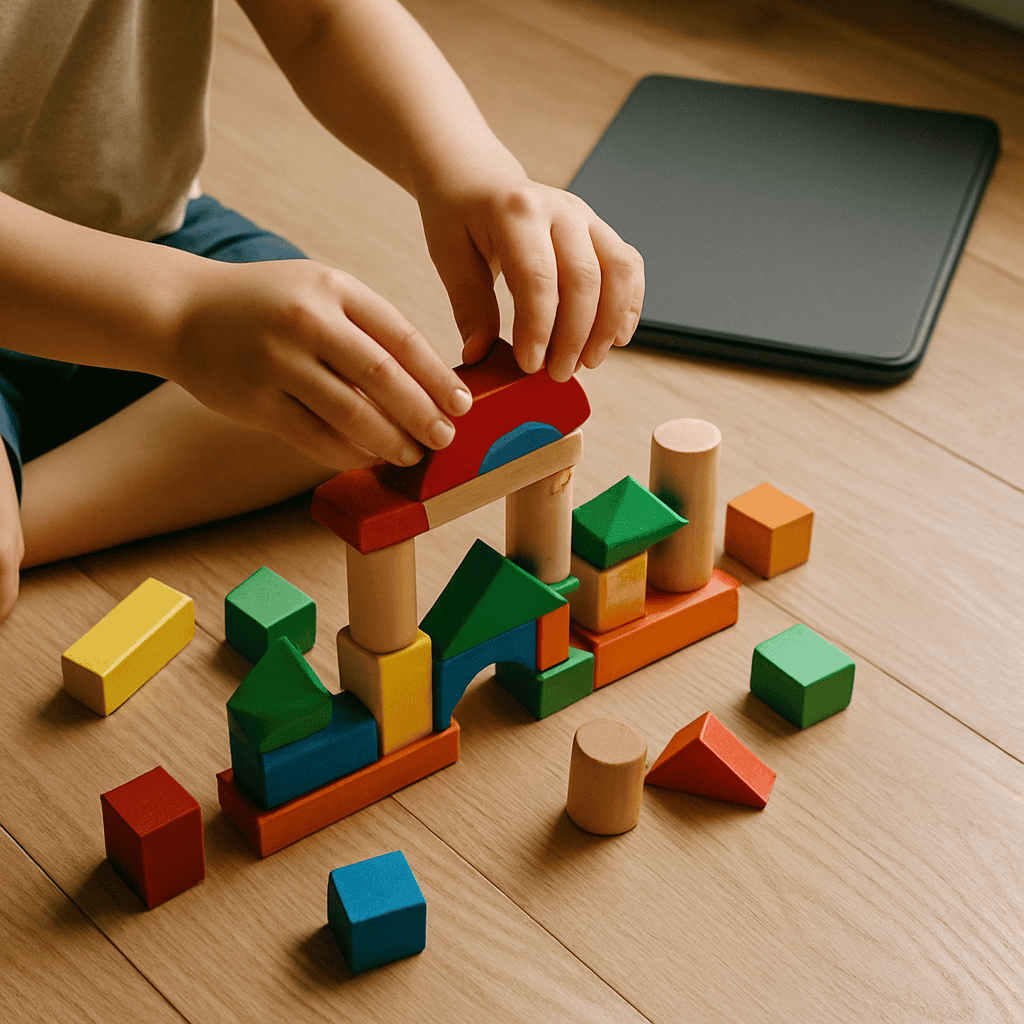
One of the most useful frames from recent research is the displacement hypothesis: the harm isn’t necessarily what’s on the screen, but what’s not happening because of the screen. When a seven-year-old spends three hours on an iPad after school, the concern isn’t just neurochemical—it’s that those three hours aren’t spent running around outside, building with blocks, or having slow, wandering conversations.
The activities screen time displaces are often the ones that build sustained attention: open-ended play, reading for pleasure, hands-on problem-solving, boredom that leads to self-generated activity. A 2020 Canadian study found that preschoolers who spent more time in unstructured outdoor play scored better on attention tasks than their screen-heavy peers—even when total “stimulation” time was held constant. The difference wasn’t stimulation; it was the kind of cognitive demand.
This is why blanket screen time limits often fail. A child who watches an hour of nature documentaries with a parent, then spends two hours building Minecraft redstone circuits, is getting very different attentional exercise than a child who scrolls YouTube autoplay for three hours. Both families might report “three hours of screen time,” but the attentional environments—and outcomes—are not equivalent.
The displacement lens also explains why screen time limits by age need flexibility. For a child whose screen time is displacing sleep or physical activity, stricter limits make sense. For a child whose screen use is social (texting friends) or creative (digital art), the calculus is different. The question isn’t “how much screen time?”—it’s “what is this screen time replacing, and does that trade-off make sense right now?”
Practical Strategies for Supporting Attention in a Screen-Heavy World
If the research doesn’t support a simple “screens = bad attention” story, what does it suggest parents do? The evidence points toward a few high-leverage strategies that focus less on policing minutes and more on shaping the attentional environment.
Prioritize content pacing over content type. Slow-paced screen content—story-driven games, long-form videos, creative apps—places fewer demands on rapid task-switching. If your child is spending significant time on screens, shifting toward slower, more deliberate content can reduce the attentional whiplash. A 45-minute movie is a different cognitive experience than 45 minutes of three-minute YouTube clips.
Build in attention “workouts.” Just as physical fitness requires varied exercise, attentional fitness requires practice across different demands. Dedicate time each day to activities that require sustained focus with no external pacing: reading aloud together, puzzles, cooking a recipe, building something with hands. These aren’t “anti-screen” activities—they’re attention training that balances what screens typically offer.
Watch for transition friction. One of the clearest behavioral signs that screen time is affecting attention is difficulty transitioning off screens. If getting your child to stop a game or video consistently results in meltdowns, that’s a signal that the screen experience is outpacing their self-regulation capacity. Understanding why transitions are hard can help you adjust pacing, duration, or the type of content to better match their attentional stamina.
Protect sleep and physical activity first. The AAP’s screen time guidance emphasizes that screen time should never displace sleep, physical activity, or face-to-face interaction. These are the non-negotiables—they’re foundational to attention development in ways that no amount of “good” screen content can replicate. If screens are cutting into bedtime, outdoor play, or family conversation, that’s the first place to intervene.
Frequently Asked Questions

Ethan Cole is a contributing writer for The Daily Well covering parenting technology, screen-time culture, family systems, and modern household organization. His background includes graduate work in business and finance, along with experience in operations, consulting, and technology systems architecture.
His work focuses on reducing real-world friction for busy families navigating modern life, with a particular interest in digital overwhelm, technology habits, productivity systems, and the intersection between modern parenting and everyday technology.



