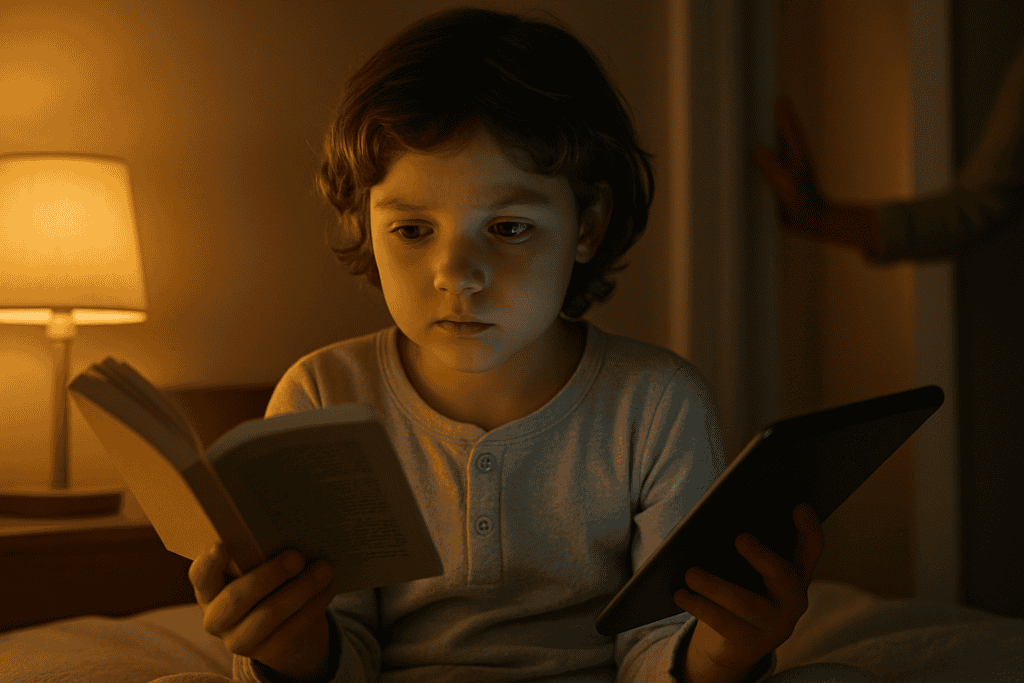
Every night, a familiar debate begins: your child wants a tablet, and you’d rather they read a book. But does it really matter which one they choose?
When comparing reading vs screens before bed, the answer involves more than blue light. Screen brightness, stimulating content, notifications, and how late children use their devices can all affect sleep.
Research suggests that activities such as gaming, messaging, and switching between apps may be particularly disruptive when children use devices in bed. Quiet reading and listening to audiobooks are different activities, but that doesn’t mean all screens are harmless before bedtime.
For most families, print books remain a simple, low-distraction choice. However, e-readers and audiobooks can offer practical alternatives when used thoughtfully.
This guide examines the evidence, compares common reading options, and explains how to establish bedtime rules that support healthy sleep.
For more guidance on managing technology at home, visit our Digital Parenting guide.
What Really Matters About Screens Before Bed?
When comparing reading vs screens before bed, three factors deserve attention: the activity, the light exposure, and when the device is used.
A 2024 study in JAMA Pediatrics tracked screen use and sleep among 79 children ages 11 to 14. Researchers found that screen use during the two hours before bedtime was not associated with most sleep measures. However, using screens after getting into bed, especially for gaming or multitasking, was associated with shorter sleep.
- Interactive content: Gaming, messaging, and switching between apps can keep children engaged when they should be winding down.
- Light exposure: Bright screens and evening light can affect the body’s sleep-wake signals. Night mode does not eliminate every concern.
- Timing: Screen use that continues after bedtime can delay attempts to sleep and reduce available sleep time.
- Device design: A dedicated e-reader offers fewer distractions than a tablet with games, notifications, and social media.
The American Academy of Pediatrics recommends avoiding screens during the hour before bedtime and keeping devices out of children’s bedrooms.
The practical takeaway: Print books remain a dependable bedtime choice. If your family uses digital reading, consider a dedicated e-reader, reduce brightness, disable notifications, and establish a firm stopping time before bed.
What Blue Light Actually Does (and Doesn’t Do) to Kids’ Sleep

Blue light isn’t a myth, but its effect on children’s sleep is more complicated than many headlines suggest.
Light helps regulate the body’s internal clock. Exposure to bright light in the evening, including the shorter wavelengths emitted by phones and tablets, can interfere with melatonin, the hormone that helps prepare the body for sleep.
Research shows that children can be particularly sensitive to evening light. A 2022 study published in the Journal of Pineal Research examined 36 preschool-age children and found substantial melatonin suppression following one hour of evening light exposure. However, the experiment tested controlled lighting conditions, not ordinary tablet use.
A more recent 2026 study published in Pediatrics Open Science compared 15 minutes of tablet viewing with picture-book reading among 32 toddlers. Researchers found no measurable differences in melatonin levels or subsequent sleep under those conditions.
These findings aren’t necessarily contradictory. The amount of light, duration of exposure, age of the child, and surrounding environment all influence how researchers interpret the results. A brief video in a familiar bedroom is different from prolonged exposure to bright light in a controlled experiment.
Night mode and warmer screen settings can reduce blue-light exposure, but they don’t eliminate the other ways devices may interfere with bedtime. Notifications, engaging content, and the temptation to keep watching can extend screen use beyond the intended stopping time.
For parents comparing reading vs screens before bed, print books remain a practical choice because they don’t emit light or introduce digital distractions.
The American Academy of Pediatrics recommends avoiding screens during the hour before bedtime and keeping devices out of children’s bedrooms overnight.
The takeaway: Reducing screen brightness may help limit light exposure, but consistent screen-free time before bed is the more dependable family rule.
Why the Activity on the Screen Matters More Than the Screen Itself
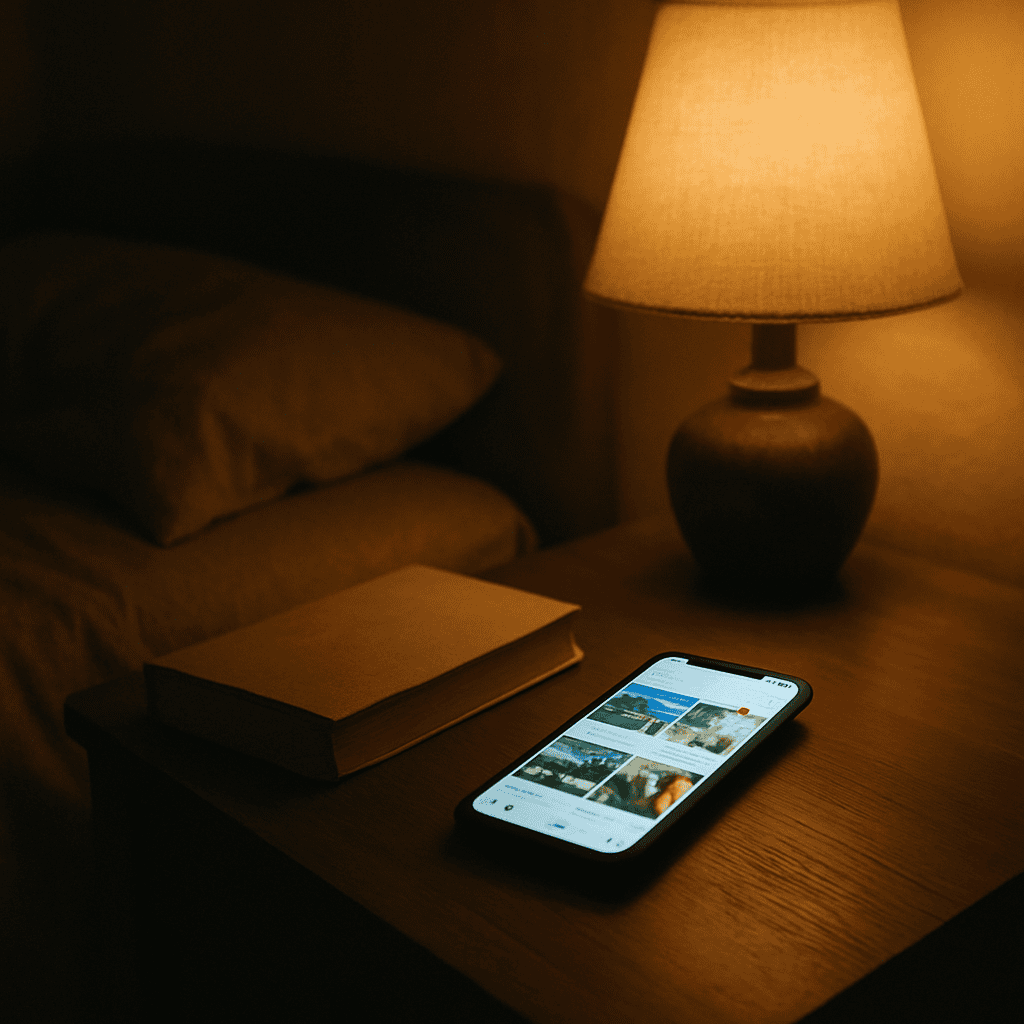
A child reading a story on an e-reader is doing something different from a child playing an online game or answering messages. The activity influences how engaged children become and how easily they can stop. But what children do, when they do it, and whether they continue after getting into bed all deserve attention.
A 2024 study published in JAMA Pediatrics examined screen use and sleep among 79 children ages 11 to 14. Researchers found that screen use during the two hours before bedtime was not associated with most sleep measures. However, screen use after getting into bed was associated with shorter sleep duration, particularly when children were gaming or multitasking.
Passive activities, including watching videos, were also associated with less sleep when they continued in bed, although the associations were generally smaller. The study was observational, so it cannot establish that screen use caused the differences in sleep.
The distinction makes practical sense. Games invite another round. Messages encourage replies. Streaming platforms automatically suggest another video. These features can make it difficult for children to stop using a device at the intended time.
Digital reading usually involves fewer interactions, especially on a dedicated e-reader without games or notifications. However, reading on a bright tablet still involves light exposure, and even an interesting book can keep a child awake longer than planned.
For parents comparing reading vs screens before bed, the goal is to make bedtime predictable:
- Choose activities that are easy to stop.
- Disable notifications and autoplay.
- Establish a consistent stopping time.
- Keep phones, tablets, and gaming devices out of bed.
The American Academy of Pediatrics recommends powering down devices before bedtime and keeping them outside children’s bedrooms overnight. Its sleep guidance for families suggests shutting screens off 30 to 60 minutes before lights-out.
The practical takeaway: A quiet digital activity may be less engaging than gaming or messaging, but that doesn’t guarantee better sleep. The most useful bedtime rule is one your child can follow consistently, with enough time left for sleep.
The Ritual and Boundary Benefits of Print Books

When comparing reading vs screens before bed, print books offer a practical advantage: they make it easier to separate bedtime from digital entertainment.
A printed book has no notifications, autoplay, advertisements, or incoming messages. Children can focus on one story without being invited to open another app. When reading becomes part of the same nightly routine, it also gives families a predictable way to wind down.
The American Academy of Pediatrics (AAP) recommends reading as part of its Brush, Book, Bed routine. The approach is straightforward: brush teeth, enjoy a book together, and go to bed at a consistent time. The AAP notes that predictable nighttime routines can help children know what to expect and reduce bedtime stress.
Shared reading offers benefits beyond sleep preparation. Parents can sit beside younger children, discuss illustrations, ask questions, and enjoy time together. The AAP also identifies reading aloud as an activity that supports children’s language development and social-emotional skills.
Print books make this interaction simple, but digital reading can work for some families, too. A dedicated e-reader without notifications or access to games may help preserve the same predictable routine. Parents can also read together using a digital book rather than leaving children to manage the device independently.
Try a simple 15-minute reading routine:
- Let your child choose between two age-appropriate books.
- Read together in a comfortable, softly lit room.
- Keep the experience relaxed rather than turning it into a reading lesson.
- Finish at an agreed stopping point, then follow the same goodnight routine.
For older children who read independently, the same principle applies: establish a consistent reading period and a clear lights-out time.
The takeaway: Print books are a dependable bedtime option because they’re easy to share, free of digital interruptions, and simple to incorporate into a routine. Consistency matters more than creating an elaborate bedtime ritual.
When E-Readers and Audiobooks Fit a Bedtime Routine
Digital reading can be part of a family’s evening routine, but the type of device and how it is used make a difference.
Dedicated e-readers often provide a simpler reading experience than tablets or smartphones. Many use electronic ink displays that resemble printed pages. Some have built-in front lighting, so they can still expose children to light at night.
Unlike a phone or tablet, a basic e-reader may offer fewer opportunities to switch between games, messages, and videos. That makes it easier to maintain a reading routine without constant interruptions.
However, research has not established that all e-readers affect sleep exactly like printed books. A 2015 study published in PNAS found that reading on a brightly illuminated electronic device before bedtime affected melatonin levels, sleep timing, and next-morning alertness compared with reading a printed book. The study involved adults using a light-emitting device, so its findings should not be applied automatically to every modern e-ink reader or child.
Audiobooks offer another alternative. Children can enjoy a story without looking at an illuminated screen. For younger children, listening together can also provide an opportunity to discuss the story and spend quiet time with a parent.
There is limited evidence that audiobooks themselves improve children’s sleep. Their practical value is that families can use them as a quiet activity without requiring children to look at a screen.
To make digital reading more bedtime-friendly:
- Choose a dedicated e-reader rather than a multipurpose tablet when possible.
- Keep screen brightness low and disable notifications.
- Select age-appropriate books or audiobooks that your child finds relaxing.
- Use an optional 15- to 30-minute audiobook timer to prevent playback continuing unnecessarily.
- Keep devices out of bed and establish a consistent lights-out time.
The American Academy of Pediatrics recommends turning screens off at least one hour before bedtime and keeping them out of children’s bedrooms.
The takeaway: Print books remain the simplest option for a screen-free bedtime. E-readers and audiobooks can be practical alternatives, provided they don’t interfere with your child’s bedtime schedule or sleep.
5 Practical Screen Rules for Better Bedtime Routines
Every family has different schedules, but managing screens before bed becomes easier when children know exactly what to expect. The goal is to establish rules that protect sleep without creating another nightly argument.
Here are five practical steps parents can follow.
1. Establish a One-Hour Screen-Free Window
The American Academy of Pediatrics recommends avoiding screens during the hour before bedtime and keeping electronic devices out of children’s bedrooms.
If your child’s bedtime is 8:30 p.m., aim to finish screen activities by 7:30 p.m. Use the remaining hour for bathing, preparing for tomorrow, reading, and other quiet activities.
A consistent stopping time is easier to enforce than negotiating for five more minutes every evening.
2. Make Screen Time Easier to End
Turn off autoplay, notifications, and unnecessary app alerts. These features can encourage children to continue watching, playing, or responding when screen time should be ending.
For younger children, use parental controls to establish automatic device limits. Give a brief warning before the scheduled stopping time so the transition isn’t unexpected.
If your child uses a tablet for reading earlier in the evening, consider restricting access to games, social media, and other distracting applications.
3. Create a Comfortable Sleep Environment
Dim bright household lights as bedtime approaches and keep bedrooms comfortable and relatively dark.
If children use electronic devices earlier in the evening, reducing screen brightness and using warmer display settings may help limit light exposure. However, these adjustments don’t replace the recommended screen-free period.
Keep phones and tablets outside the bedroom overnight, particularly when notifications or late-night entertainment could interrupt sleep.
4. Adjust the Routine to Your Child’s Needs
Younger children may need a parent to manage device access and guide the transition to bedtime.
Older children and teenagers can participate in setting reasonable household rules, including where devices charge overnight and when screens must be turned off.
Children who struggle with transitions may benefit from a visual schedule, predictable reminders, or an established sequence of bedtime activities. Adapt the routine to your child’s needs without assuming that one approach works for everyone.
5. Follow the Same Rules Yourself
Children notice when parents continue scrolling while telling them to put their devices away.
Consider establishing a shared household routine: phones charge outside bedrooms, televisions go off at an agreed time, and family members choose quieter evening activities.
The American Academy of Pediatrics’ Family Media Plan offers additional guidance for establishing consistent household media rules.
The takeaway: You don’t need a complicated technology policy. A predictable stopping time, fewer digital distractions, and a consistent bedtime routine provide a practical starting point for better sleep habits.
Frequently Asked Questions

Ethan Cole is a contributing writer for The Daily Well covering parenting technology, screen-time culture, family systems, and modern household organization. His background includes graduate work in business and finance, along with experience in operations, consulting, and technology systems architecture.
His work focuses on reducing real-world friction for busy families navigating modern life, with a particular interest in digital overwhelm, technology habits, productivity systems, and the intersection between modern parenting and everyday technology.



