
Most family phone contract templates fail before the first paragraph is read — not because they’re unreasonable, but because they ask the child to agree to something the parents themselves designed without input. The contract becomes enforcement paperwork, not a shared agreement. By the time you print it, your kid has already mentally opted out.
The best family phone contract template is one your child helps build, one that anticipates their actual friction points, and one that names the trade-offs instead of hiding them. This guide walks you through a flexible kids phone contract framework that adapts to your family’s actual dynamics — plus the negotiating moves most parents skip. For broader context on digital parenting systems, this contract is one piece of a larger tech decision framework.
The Negotiation Principle
Key Insight: The contract doesn’t create compliance — the negotiation does.
When a child co-authors the family phone contract template, they internalize the reasoning behind each rule. Contracts imposed unilaterally feel like surveillance; contracts built collaboratively feel like earned independence. The process of negotiating trade-offs — “You want TikTok; we need to see screen time reports weekly” — is where the learning happens, not in the signing ceremony.
- Unilateral contracts feel like restriction documents
- Co-authored contracts feel like earned independence markers
- The debate over each clause teaches judgment in real time
- Signing becomes meaningful when the child shaped the terms
Frame the conversation as “What do we both need to feel okay about this phone?” rather than “Here are the rules you’ll follow.”
Start with the Ownership Question Every Family Phone Contract Template Avoids
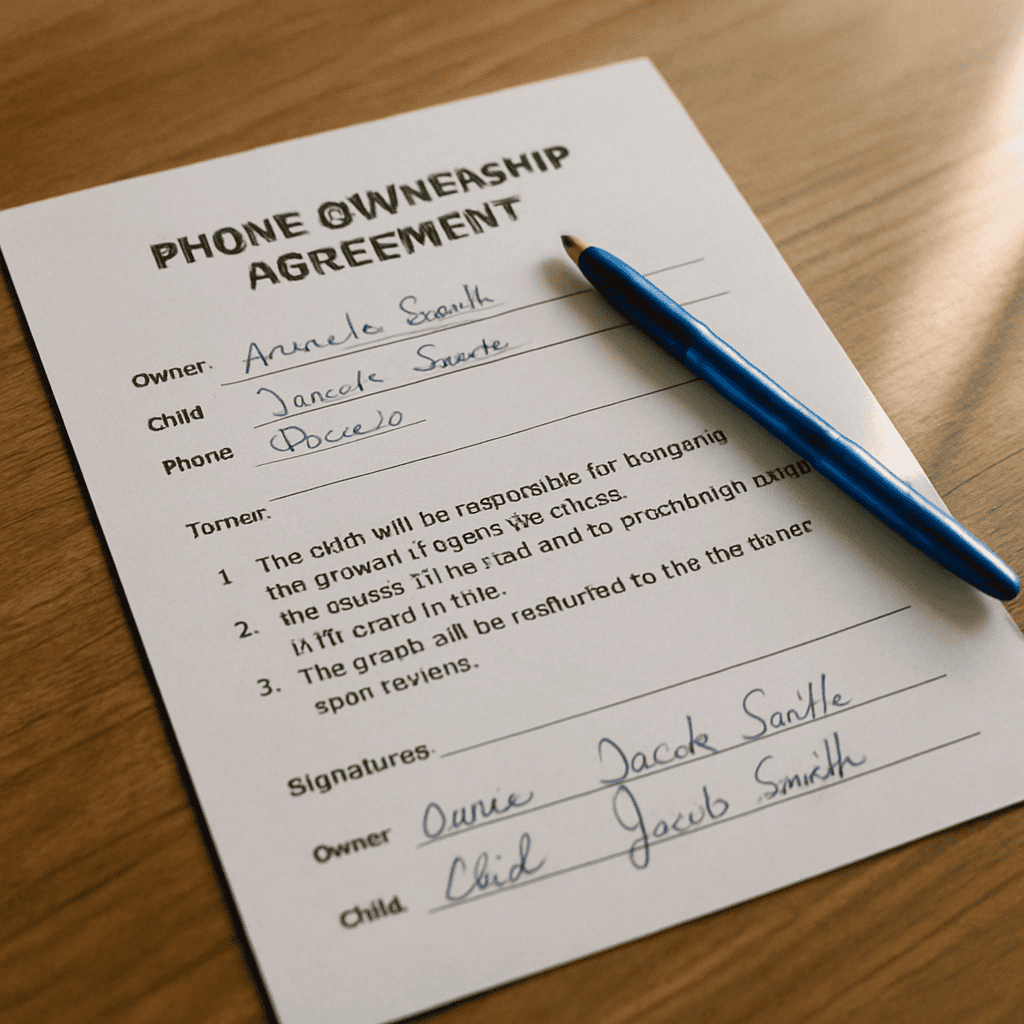
Before drafting your family phone contract template, name who owns the phone — legally and practically. If the parents bought it and pay the bill, the phone belongs to the family, not the child. This isn’t pedantry; it’s the foundation of every rule that follows. When a 12-year-old says “It’s my phone,” they’re operating from a different mental model than you are.
Open the negotiation with this framing: “We’re buying you access to this phone. You’re earning the right to use it independently. The phone itself stays part of the family tech ecosystem, which means we have admin access, we can check it, and we can take it back if the agreement breaks down.” Most teens will accept this if you say it clearly at the start. What they won’t accept is discovering it later, mid-conflict, as a surprise power move.
Document this in the contract’s preamble. A simple sentence — “This phone is owned by [Parent Names] and licensed to [Child Name] under the terms below” — sets the tone. It also differentiates your family phone contract template from aspirational “digital citizenship pledges” that obscure the power dynamic. Teens respect clarity more than they respect vague inspirational language.
The Six Core Clauses That Belong in Every Kids Phone Contract

Your family phone contract template needs to cover six operational domains — each one a negotiation point, not a decree. These six clauses map to the actual friction points families encounter in the first 90 days of phone ownership, according to ConnectSafely’s research on family tech agreements.
1. Device Access & Privacy
Parents will have the passcode and can check the phone at any time, with or without notice. This is the hardest clause for teens to accept, but it’s non-negotiable for kids under 14. The negotiation is how often and under what conditions. Offer a trade: random checks happen monthly unless there’s a specific concern; weekly checks happen if trust breaks down. Frame it as a trust ladder, not a surveillance regime.
2. Apps & Platforms
Which apps are allowed, which require parent approval, which are banned. Let the child propose their list first. Most will ask for messaging (Snapchat, Instagram DMs), social video (TikTok, YouTube), and gaming. Your job is to say which ones require a waiting period and why. Be specific: “TikTok after 13th birthday” is clearer than “social media when you’re ready.”
3. Time & Location Boundaries
When the phone must be turned in at night (we recommend 45 minutes before target bedtime), where it’s not allowed (dinner table, car rides over 20 minutes, bedrooms after 9pm), and how location sharing works. If you’re using iPhone Family Sharing or Life360, name it here. The trade-off: location sharing is the price of independent mobility.
4. Spending & Purchases
In-app purchases, subscriptions, paid apps — all require explicit approval. Set up parental approval in Apple Family Sharing or Google Family Link. Write into your family phone contract template: “Any purchase attempt without permission results in [consequence].”
5. Communication Boundaries
Who the child can contact, what to do if a stranger messages them, how to handle group chat conflicts. This is where you teach judgment, not compliance. Role-play scenarios: “If someone asks for a photo, you…” Let them finish the sentence, then refine it together.
6. Consequences & Escalation
What happens when a rule is broken. Most contracts fail here because they threaten nuclear options (“Phone gets taken away for a month”) that parents don’t enforce. Instead, build a ladder: first offense = conversation + 24-hour phone loss; second offense = week-long loss + app restrictions; third offense = reset to dumbphone or smartwatch. Proportional, predictable, enforced.
How to Adapt the Teen Phone Agreement for Different Ages

A family phone contract template for an 11-year-old should not look like one for a 16-year-old. The core clauses stay the same; the negotiation latitude expands with age. Here’s how to scale your teen phone agreement by developmental stage, guided by AAP screen time guidance.
Ages 10-12 (first phone, often a hand-me-down): Full parental access, no negotiation. Apps are whitelisted — the child can only download apps you’ve pre-approved. Social media is typically off-limits. Location sharing is mandatory. Phone stays in the kitchen overnight, every night. This is the training-wheels phase. The child is earning independence, not exercising it yet. Your kids phone contract should emphasize learning and observation, not autonomy.
Ages 13-14 (middle school social pressure peaks): Limited negotiation on apps. Social media may be introduced with restrictions (viewing only, no posting; or posting with parent follow). Passcode privacy is still not granted, but check frequency can drop to biweekly if trust is demonstrated. Location sharing remains mandatory. Introduce the concept of “earned privacy” — if three months pass without a rule violation, checks become monthly. This is the phase where your family phone contract template becomes a living document, not a static rulebook.
Ages 15-17 (high school, driving, part-time work): Significant negotiation latitude. The teen may propose their own screen time limits. Passcode privacy may be granted with the understanding that parents can still request access with 24-hour notice (except in emergencies). Social media restrictions lift for most families. The teen phone agreement shifts from behavior control to risk management — focus on who they’re talking to and what they’re sharing, not how long they’re on the phone. If they’re driving, location sharing becomes a safety feature they’ll often accept voluntarily.
The progression from control to autonomy should feel predictable. If your 15-year-old is still operating under the same rules as your 11-year-old, the contract has failed. Build in scheduled renegotiations — every birthday, every school transition, every time they demonstrate sustained responsibility. For related guidance on readiness, see when should a child get a phone.
The Printable Family Phone Contract Template (Fill-in-the-Blank Framework)
This is the template you can adapt, print, and co-sign. Fill in the bracketed sections together with your child. The act of filling it in together — debating each blank — is the point. A family phone contract template only works if the child feels they shaped it.
For a downloadable / printable child’s phone contract, click here.
Phone Ownership Agreement
This phone is owned by [Parent Names] and licensed for use by [Child Name], beginning [Date]. This agreement will be reviewed on [Review Date, typically 6 months or 1 year later].
Access & Privacy
Parents will have the passcode at all times. Parents may check the phone [frequency: weekly/biweekly/monthly] and at any time if there is a specific concern. [Child Name] agrees to unlock the phone immediately when asked.
Apps & Content
Allowed apps: [list]. Apps that require approval: [list]. Banned apps: [list]. New apps require approval before downloading. Social media accounts: [list which platforms are allowed, which require parent follow, which are banned].
Time & Location
Phone must be turned in at [time] each night and will be returned at [time] each morning. Phone is not allowed at: [dinner table, bedroom after X time, school except lunch/emergency, etc.]. Location sharing is [on/off], managed through [app/service].
Communication
[Child Name] agrees to: respond to parent texts within [time frame], never delete messages to hide them, tell a parent immediately if contacted by a stranger, and show a parent any message that feels uncomfortable.
Spending
No purchases, subscriptions, or paid apps without explicit approval. Violations result in [consequence].
Consequences
First rule violation: [conversation + 24-hour phone removal]. Second violation: [week-long removal + app restrictions]. Third violation: [phone replaced with basic device or smartwatch for 30 days]. Serious violations (sharing explicit content, cyberbullying, etc.): [immediate full lockdown, parent discretion on return timeline].
Signatures
[Child Name] ________ Date ______
[Parent Name] ________ Date ______
Print two copies. One goes in the family command center or kitchen drawer. One goes in the child’s room. When conflict arises, you pull out the contract and read the clause together. The contract becomes the bad guy, not you.
Why Most Family Phone Contract Templates Fail (and How to Avoid the Common Traps)
The failure modes are predictable. Parents download a generic family phone contract template from the internet, print it, hand it to the child, and expect compliance. The child skims it, signs it to get the phone, and ignores it within a week. Within a month, the contract is forgotten. Within three months, parents are threatening punishments that weren’t in the contract, and the child is citing clauses the parents don’t remember agreeing to.
The most common failure: contracts that are too detailed. Sixteen-clause, two-page single-spaced documents that read like software license agreements. No 12-year-old is reading that. No parent is enforcing that. Your family phone contract template should fit on one page, double-spaced, with wide margins. If you need two pages, you’re writing policy, not agreement.
The second failure: consequences that are too severe. “Phone taken away for a month” sounds strong when you’re drafting the contract. But when your kid misses one check-in text and you’re supposed to confiscate the phone for 30 days, you won’t do it. And the child knows you won’t. The contract becomes unenforceable, and enforcement becomes arbitrary. Better to write “Phone removed for 24 hours” and actually do it every single time. Consistency beats severity.
The third failure: no scheduled renegotiation. A family phone contract template signed at age 11 should not still be in effect at age 14. The child has grown. Their needs have changed. Their peer context has shifted. If you don’t build in a renegotiation date, the contract fossilizes, and the child starts operating outside it because it no longer fits their reality. Every six months for kids under 13; annually for teens 13 and up. Put the date in the contract.
Finally: parents who don’t follow their own rules. If the contract says “no phones at the dinner table,” and Mom is answering work emails while the kid’s phone is in the kitchen drawer, the contract has no moral weight. The teen phone agreement has to bind everyone, or it binds no one. Consider adding a parent clause: “Parents agree to model healthy phone use by [specific behaviors].” It makes the contract feel less like a power play.
The goal is not perfect compliance. The goal is a shared reference point when things go sideways — and they will. For ongoing guidance on balancing independence and oversight, see should you track your teen.
Frequently Asked Questions

Ethan Cole is a contributing writer for The Daily Well covering parenting technology, screen-time culture, family systems, and modern household organization. His background includes graduate work in business and finance, along with experience in operations, consulting, and technology systems architecture.
His work focuses on reducing real-world friction for busy families navigating modern life, with a particular interest in digital overwhelm, technology habits, productivity systems, and the intersection between modern parenting and everyday technology.



