
The front door opens at 3:47 p.m., and within ninety seconds your child is ransacking the pantry, dissolving into tears over homework, or fighting with a sibling. The culprit isn’t attitude—it’s blood sugar. After six or seven hours of metabolic effort, most children arrive home functionally depleted, and the next thirty minutes are a predictable flashpoint. Effective after-school snack systems don’t just prevent the meltdown; they create a structured decompression window that bridges the gap between school and dinner without displacing the evening meal.
This article is part of our broader guide to Family Routines. Most parents know snacks matter, but few treat them as part of a broader family routines framework that manages transitions rather than reacting to them. The difference between a snack and a snack system is predictability: time, place, portion, and cleanup all become non-negotiable architecture, not minute-by-minute negotiations.
The Depletion Window
Key Insight: The post-school crash isn’t behavioral—it’s metabolic, and it arrives on a predictable schedule tied to cortisol rhythm and glycogen depletion.
Children who eat lunch between 11:30 a.m. and 12:15 p.m. reach a physiological low point between 3:30 and 4:15 p.m., typically 15 to 45 minutes after arriving home. During this window, executive function drops, emotional regulation weakens, and conflict becomes nearly inevitable. Structured after-school snack systems anticipate this window rather than reacting to it.
- Snack timing must be immediate (within 10 minutes of arrival), not conditional on behavior or homework completion
- Portion size matters: too little and the child grazes for an hour; too much and dinner appetite disappears
- Predictability reduces negotiation friction—kids stop lobbying for different foods when the system is consistent
- Cleanup becomes part of the routine, not a separate battle
The goal is a 15-minute structured pause that raises blood sugar, provides sensory decompression, and closes before homework or activities begin.
Why After-School Snack Systems Fail (And What Actually Works)
Most households approach after school snacks for kids reactively: the child announces hunger, a negotiation begins, the parent offers something, the child rejects it, and ten minutes evaporate in conflict. This pattern trains children to treat snack time as a negotiation opportunity rather than a predictable routine. Successful after-school snack systems remove the negotiation entirely by making time, location, and options non-negotiable.
The most common failure point is portion creep. A snack that begins as a string cheese and crackers expands over weeks into a multi-course graze that displaces dinner appetite. According to the Academy of Nutrition and Dietetics’ snack guidance, the ideal after-school portion delivers 150 to 250 calories—enough to stabilize blood sugar without competing with dinner two hours later.
Another breakdown point: location drift. Snacks migrate from the kitchen table to the couch, the car, bedrooms, homework desks. When snack location becomes variable, cleanup becomes harder to enforce, and the routine loses its boundary. A snack routine after school works because it’s bounded in time and space—fifteen minutes, one location, predictable end point.
The final structural weakness is the open-ended snack. Children who are told “grab something from the pantry” face choice overload in a moment of low executive function, and they default to the highest-sugar, lowest-effort option. Offering two pre-portioned options eliminates decision fatigue and ensures nutritional balance without requiring the child to self-regulate in a depleted state.
Building a Snack Station That Runs Itself

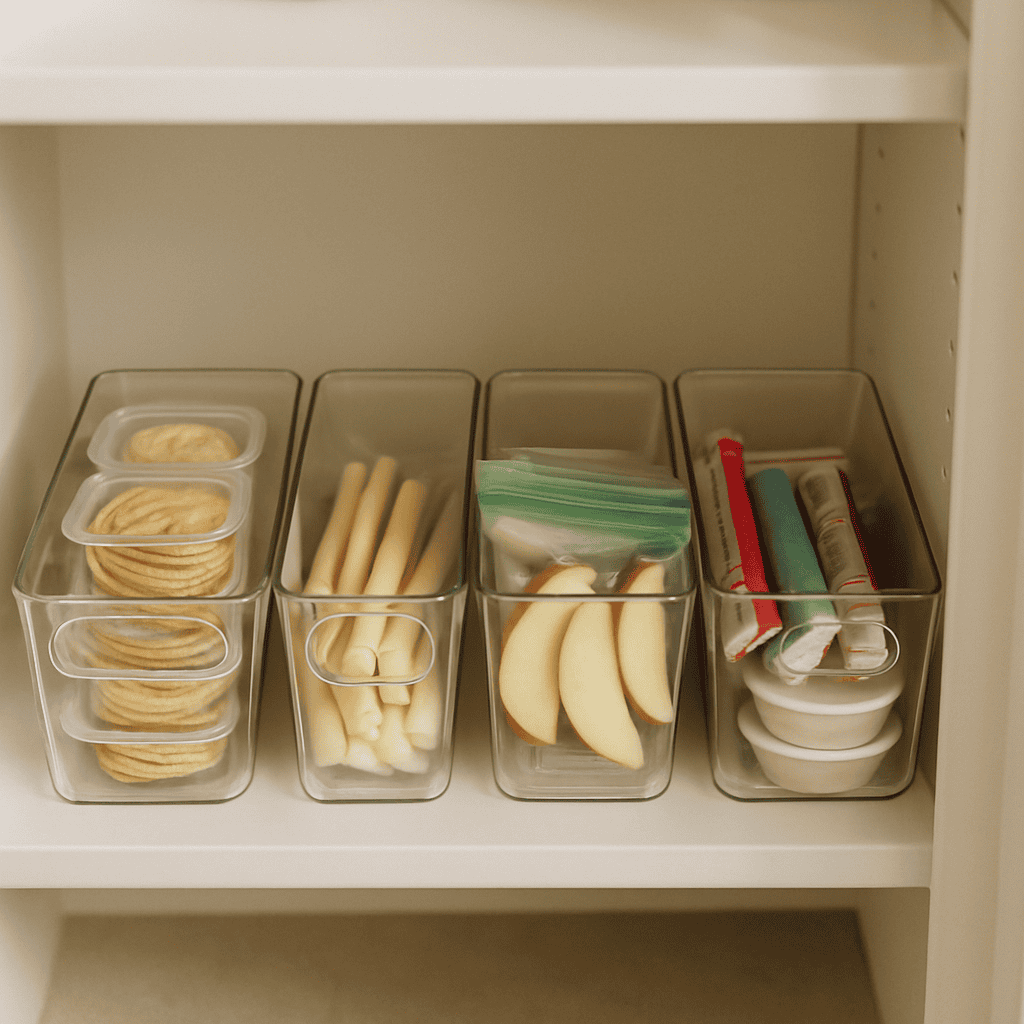
The most sustainable after-school snack systems operate with minimal adult intervention once the structure is in place. A dedicated snack station—whether a low pantry shelf, a labeled bin in the fridge, or a rolling cart—gives children agency within boundaries. The station holds pre-portioned options rotated weekly, and children choose one item from column A (protein or fat) and one from column B (carbohydrate or fruit).
Effective snack stations share three features: visibility, accessibility, and portion control. Everything is at child eye level, packaged in single servings, and limited to six or eight options. When children can see and reach their choices without asking for help, the system becomes self-service. A typical station might include small containers of hummus, cheese cubes, hard-boiled eggs, nut butter packs, apple slices, whole-grain crackers, mini bell peppers, and yogurt tubes.
Portion control is non-negotiable. A child who is told “have some crackers” will eat until the box is empty; a child handed a small bowl with twelve crackers stops when the bowl is empty. Pre-portioning can happen during Sunday meal prep (bagging snacks for the week) or via reusable portion containers that get refilled each morning. The key is that portion size is decided by the parent in a calm moment, not negotiated by the child in a dysregulated one.
The station model also makes cleanup automatic. Snack happens at the table, dishes go into a designated bin or directly into the dishwasher, and the child returns the station items to their spots. When the fifteen-minute timer ends, snack time is over—even if the child hasn’t finished. This boundary prevents the snack from expanding into an hour-long graze and preserves the structure that makes the system work.
The Two-Tier System for Multiple Kids and Dietary Needs
Households with multiple children or varied dietary needs require a more modular approach. A two-tier after-school snack system provides a universal base option (available to everyone) and individualized add-ons for children with higher caloric needs, allergies, or preferences. The base option is always the same—something like apple slices and string cheese—and the add-on rotates based on the child’s age, activity level, or dietary restrictions.
This structure prevents sibling comparison battles. When the base is identical and the add-on is framed as matching the child’s specific need (soccer practice, nut allergy, age-based energy requirement), children perceive the difference as functional rather than preferential. A younger child might receive the base only; an older child heading to a two-hour sports practice gets the base plus a granola bar or a handful of trail mix.
For families managing food allergies, the two-tier model simplifies cross-contamination risk. The base snack is always allergen-free, and allergen-containing add-ons (peanut butter, dairy) are handled separately with clear handwashing and surface-wipe protocols. Labeling each child’s add-on container with their name and a color code reduces confusion and empowers children to self-serve safely.
Sibling arrival time stagger is another friction point the two-tier system solves. If one child arrives home at 3:15 and another at 4:00, the first child’s snack window closes before the second child’s opens. The universal base snack can be pre-set on the table for each arrival time, and the parent only needs to manage the individualized add-on when the child walks in. This approach prevents the early-arrival child from grazing continuously while waiting for a sibling and maintains the bounded structure that makes after-school snack systems effective.
Timing, Transition Cues, and the Dinner Appetite Problem
The most persistent parent objection to structured after school snacks for kids is the fear of displacing dinner appetite. The research is clear: a 150-to-250-calorie snack consumed between 3:30 and 4:15 p.m. does not reduce dinner intake when dinner is served between 6:00 and 6:30 p.m. The problem arises when snack portions exceed 300 calories, when snack time extends past 4:30 p.m., or when children graze continuously rather than eating a bounded portion.
Timing discipline is the key variable. Child Mind Institute’s research on transitions emphasizes that children need clear start and end signals to move between activities without resistance. A fifteen-minute visual timer, placed on the table during snack time, gives children a concrete end point and eliminates the negotiation over “just a few more bites.” When the timer rings, snack is over, and the transition to homework or free play is non-negotiable.
Transition cues also help. Some families use a specific plate or placemat that only appears during snack time; others play a short playlist that signals the snack window. The cue becomes a Pavlovian signal that this is a bounded event, not an open-ended opportunity. Over time, children internalize the boundary and stop resisting the transition out of snack time.
The dinner appetite problem almost always traces back to one of three errors: snack portions too large, snack timing too late, or continuous grazing instead of a bounded snack. If a child consistently refuses dinner after implementing a snack routine after school, reduce the snack portion by 25 percent for one week and observe. Most parents discover they’ve been over-portioning out of fear the child will still be hungry, when in reality a smaller snack plus a two-hour gap is exactly the formula that preserves dinner appetite.
Adapting After-School Snack Systems for Extracurriculars and Late Arrivals
The classic 3:30 p.m. kitchen-table snack works beautifully for children who arrive home on a bus and stay there until dinner. But many families juggle sports practices, tutoring, music lessons, and staggered sibling schedules that make a single snack window impractical. The solution is a mobile snack kit and a revised timing protocol that moves the snack to the car, the field, or the lesson waiting room without abandoning the system’s core structure.
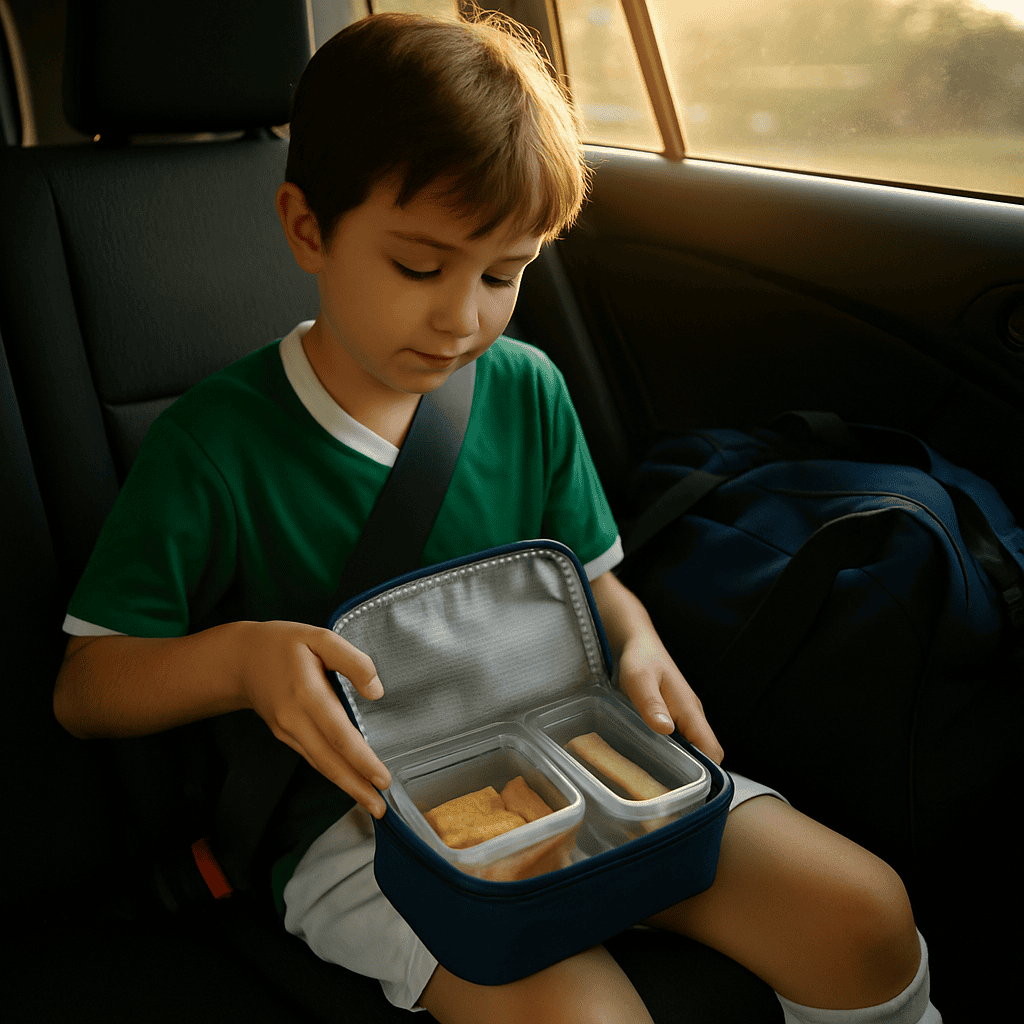
A mobile snack kit lives in the car and contains the same bounded portion and two-option structure as the home snack station. A small insulated bag holds a protein option (cheese stick, nut butter pack, hard-boiled egg) and a carbohydrate option (crackers, pretzels, fruit pouch), pre-portioned into reusable containers. The child eats the snack in the car during the drive to the activity, or on a bench immediately before practice begins. The fifteen-minute boundary still applies—snack is consumed in one sitting, not grazed over an hour between drills.
For children who don’t arrive home until 5:00 or 5:30 p.m., the timing logic reverses. These children often ate a late lunch (12:30 or 1:00 p.m.) and participated in an afterschool program that provided a small snack around 3:00 p.m. By the time they reach home, they’re within ninety minutes of dinner, and a full snack will displace the meal. In this case, the after-school snack system compresses into a bridging snack: a single small item (half an apple, a handful of crackers, six baby carrots) designed only to prevent a blood-sugar crash, not to provide substantial calories. Dinner moves earlier if possible, or the child receives a slightly larger breakfast and lunch to compensate for the compressed afternoon eating window.
Families with multiple children on different schedules often find that a hybrid approach works best: one child gets a full snack at home at 3:30, another gets a mobile kit in the car at 4:15, and a third gets a bridging snack at 5:00. The key is that each child’s snack is still bounded, predictable, and appropriate to their individual metabolic window. The structure flexes to accommodate logistics, but the principles—timing, portion control, bounded duration—remain constant.
Frequently Asked Questions

Lena Carter is a contributing writer for The Daily Well, focusing on practical routines, family systems, and everyday strategies for modern households. With experience managing the demands of a busy home and balancing the realities of modern family life, her work centers on simple, sustainable approaches that reduce stress and create more stability in the day-to-day.
Her writing explores parenting routines, household organization, emotional overwhelm, and the small systems that help families function more smoothly in real life — not just in theory.


