
Most parents of energetic, distracted, or impulsive kids wonder at some point: is this typical development, or could it be ADHD? The question is complicated by the fact that many signs of ADHD in kids—forgetting instructions, interrupting, losing focus—are also common in neurotypical children at certain ages. The distinction lies not in whether a behavior appears, but in its pattern, severity, and impact. This article walks through a practical framework for recognizing when everyday kid behavior crosses into territory that warrants professional evaluation.
Understanding the signs of ADHD in kids is part of our broader guide to school and learning challenges. We’ll help you differentiate ADHD symptoms in children from age-appropriate immaturity, identify red flags that suggest a real evaluation, and give you language to use with your pediatrician or school when concerns arise.
The Cross-Context Persistence Test
Key Insight: ADHD symptoms persist across multiple settings—home, school, playdates, extracurriculars—whereas situational behavior problems are usually environment-specific.
Neurotypical kids who struggle with focus in one setting (a chaotic classroom, a boring task) often self-regulate in others. Kids with ADHD show the same inattention, hyperactivity, or impulsivity regardless of setting, adult, or motivation level. This cross-context persistence is the single most reliable early indicator parents can observe without professional tools.
- Does your child lose focus during preferred activities (video games, Lego builds) as often as during chores?
- Do multiple adults—teachers, coaches, grandparents—report the same concerns unprompted?
- Does the behavior show up at home, school, and social settings over a period of six months or more?
- Does external motivation (rewards, consequences) have little to no effect on the behavior?
If the answer to most of these is yes, you’re observing a pattern that merits a conversation with your pediatrician or a school psychologist.
Understanding ADHD vs Developmental Immaturity

One of the most common sources of confusion around signs of ADHD in kids is the overlap with immaturity. A six-year-old who can’t sit still during a long dinner is behaving age-appropriately. A ten-year-old who physically cannot remain seated during a twenty-minute homework session—and hasn’t been able to for years—may be showing ADHD symptoms in children. According to a CDC overview of ADHD and behavior therapy, the disorder is defined by symptoms that are developmentally inappropriate for the child’s age, not just annoying or inconvenient for adults.
Developmental benchmarks matter. A preschooler’s attention span is roughly three to five minutes per year of age, so expecting a four-year-old to sustain focus for twenty minutes is unrealistic. By age eight, most neurotypical children can stay on task for thirty to forty minutes with occasional reminders. If your child at that age still requires constant redirection, loses track mid-sentence, or forgets instructions seconds after hearing them—and this happens daily, across settings—you’re observing something beyond immaturity.
Executive function development also plays a role. Skills like planning, organizing, and impulse control mature gradually through adolescence. But children with ADHD often lag three to five years behind peers in executive function, which shows up as chronic disorganization, inability to estimate time, and extreme difficulty following multi-step directions. The gap widens as academic and social demands increase, making middle school a common inflection point for diagnosis even when signs of ADHD in kids were present earlier.
The Three Core Symptom Domains of ADHD

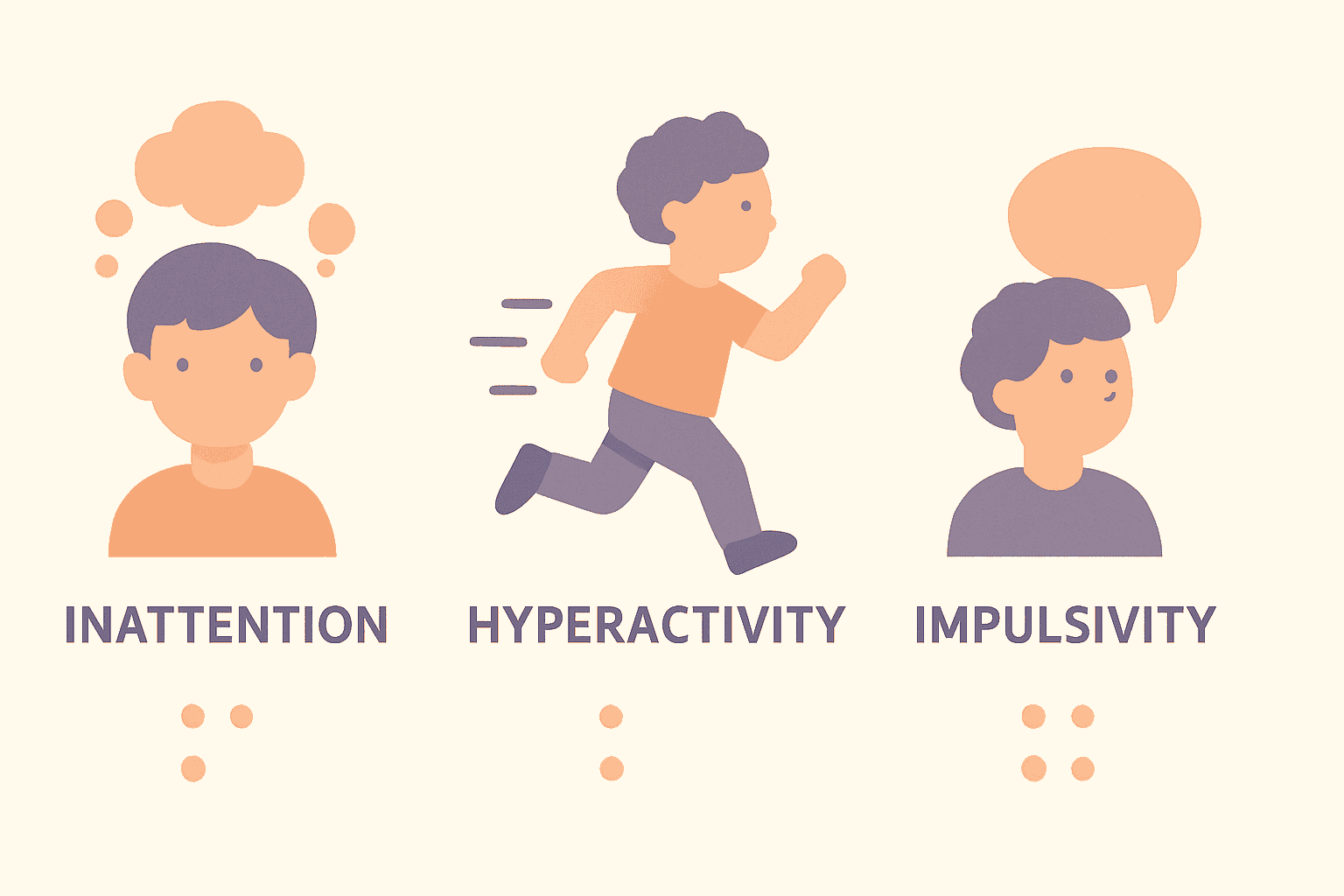
ADHD symptoms in children cluster into three domains: inattention, hyperactivity, and impulsivity. Not every child shows all three. Some are primarily inattentive (the “daydreamy” kid), others primarily hyperactive-impulsive (the “motor running constantly” kid), and many show a combined presentation. Each domain has specific behavioral markers that parents and teachers can observe.
Inattention signs of ADHD in kids include difficulty sustaining focus on tasks, frequent careless mistakes despite effort, appearing not to listen when spoken to directly, failing to finish schoolwork or chores, avoiding tasks requiring sustained mental effort, losing items daily (jackets, homework, water bottles), being easily distracted by irrelevant stimuli, and chronic forgetfulness in daily routines. One key distinction: neurotypical kids lose focus when bored or tired, but kids with ADHD lose focus even during activities they enjoy and even when well-rested.
Hyperactivity shows up as fidgeting or squirming when seated, leaving seat in situations where sitting is expected (classroom, dinner table), running or climbing in inappropriate contexts, inability to play quietly, being “on the go” as if “driven by a motor,” and talking excessively. It’s not just high energy—it’s energy the child cannot modulate even when they want to. A child who can sit through a favorite movie without constant movement is probably just energetic; a child who cannot sit through anything, ever, may be showing hyperactivity that warrants evaluation.
Impulsivity includes blurting out answers before questions are finished, difficulty waiting their turn, interrupting or intruding on others, making decisions without considering consequences, and taking physical risks without awareness. Impulsivity in ADHD isn’t willful defiance—it’s a failure of the brain’s inhibitory control system. The child often feels regret immediately after the behavior but cannot stop it in the moment. If your child frequently says “I didn’t mean to” or “I forgot” after impulsive actions, and this pattern has persisted for years, you’re observing a core ADHD symptom.
Red Flags That Warrant Professional Evaluation
Not every sign of ADHD in kids requires a formal evaluation. But certain red flags—especially when they cluster—suggest it’s time to consult a pediatrician, child psychologist, or school evaluation team. CHADD’s parent guide emphasizes that impairment, not just symptom presence, is the threshold for diagnosis. The question isn’t “Does my child have these behaviors?” but “Are these behaviors significantly impairing their functioning?”
Academic impairment is a major red flag. If your child’s intelligence and effort don’t match their grades, if they can explain concepts verbally but can’t produce written work, if homework takes three times longer than it should, or if they’re falling behind peers despite tutoring, the gap may reflect ADHD’s impact on executive function and sustained attention. Teachers often notice this first: the child who “isn’t working to potential” or “could do better if they tried harder” may actually be trying very hard against neurological constraints.
Social impairment is equally significant. Kids with ADHD often struggle to read social cues, wait their turn in conversation, or regulate their emotional reactions. They may be left out of playdates, labeled as “too much,” or have frequent friendship conflicts despite genuinely wanting connection. If your child is socially isolated, frequently rejected by peers, or has a pattern of short-lived friendships that end in conflict, ADHD symptoms in children—especially impulsivity and emotional dysregulation—may be contributing factors.
Emotional dysregulation is another key marker. Many children with ADHD have extreme, rapid emotional reactions—meltdowns that seem disproportionate to the trigger, difficulty calming down once upset, low frustration tolerance, and emotional sensitivity that peers have outgrown. This isn’t about being “sensitive” or “dramatic”; it’s a core feature of ADHD’s impact on the brain’s regulatory systems. If emotional storms are disrupting family life weekly, evaluation is warranted. For more context on how ADHD intersects with school challenges, see our guide on ADHD and schoolwork support.
When “ADHD or Just Being a Kid” Becomes a Clinical Question
The phrase “ADHD or just being a kid” reflects a real diagnostic challenge: nearly every symptom of ADHD appears, at least occasionally, in typically developing children. The clinical threshold is reached when symptoms are present for six months or more, appear before age twelve, occur in two or more settings, and cause significant impairment in social, academic, or family functioning. Without that combination, what you’re observing is probably developmental variation, temperament, or a situational stressor—not ADHD.
One practical test is the response-to-intervention pattern. Neurotypical kids generally respond well to structure, positive reinforcement, and clear expectations. If your child’s behavior improves dramatically with a sticker chart, predictable routines, or one-on-one attention, they’re probably showing typical kid behavior that benefits from good parenting strategies. Kids with ADHD often show little to no improvement even with gold-star parenting, consistent routines, and external motivation. That lack of response is itself diagnostic information.
Another lens is the skill-versus-will distinction. Typical kid behavior involves choosing not to do something (won’t sit still because they’d rather play). ADHD involves neurological inability to do something even when the child wants to (can’t sit still even during a highly desired activity). Parents often describe this as “it’s like he’s trying, but his body won’t cooperate” or “she wants to focus, but her brain just won’t let her.” That “can’t, not won’t” pattern is central to recognizing signs of ADHD in kids.
Context also matters. A child who becomes hyperactive, inattentive, or impulsive only after a major life stressor—divorce, a move, a new sibling—is probably reacting to stress, not showing ADHD. ADHD symptoms are chronic and pervasive, not situational. If the behaviors appeared suddenly or are tied to a specific trigger, address the stressor first before pursuing an ADHD evaluation. According to research reviewed by ADDitude Magazine’s parenting section, many children initially flagged for ADHD are actually experiencing anxiety, trauma response, or environmental chaos that mimics ADHD symptoms.
How to Start the Evaluation Process
If you’ve identified persistent, cross-context signs of ADHD in kids and the behaviors are causing real impairment, the next step is formal evaluation. Start with your child’s pediatrician. Bring specific examples—not “he’s hyper,” but “he cannot stay seated during a meal, leaves his seat in class daily despite repeated consequences, and has been doing this for two years.” Specificity helps the pediatrician distinguish ADHD from other causes (sleep disorders, anxiety, sensory processing issues, or even vision/hearing problems can mimic ADHD symptoms in children).
Your pediatrician will likely use standardized rating scales—tools like the Vanderbilt or Conners—that you and your child’s teacher complete. These scales quantify the frequency and severity of ADHD symptoms in different settings and compare them to age norms. A comprehensive evaluation also includes developmental history, family history (ADHD is highly heritable), and ruling out other conditions. Vision and hearing screenings are standard, as are questions about sleep, anxiety, and trauma exposure.
Schools can also conduct evaluations, especially if academic impairment is significant. Under federal law, parents can request a free evaluation if they suspect a disability (including ADHD) is affecting their child’s education. The school’s evaluation focuses on educational impact and may lead to an Individualized Education Program (IEP) or a 504 plan. For guidance on that process, see our article on how to request an IEP evaluation.
Private neuropsychological testing is another option, especially if school evaluations are delayed or if you want a comprehensive profile of your child’s strengths and weaknesses. Neuropsych testing assesses executive function, working memory, processing speed, and attention in detail, and it can identify co-occurring conditions like dyslexia, anxiety, or giftedness. It’s expensive (often $2,000–$4,000) and not always covered by insurance, but it provides a depth of insight that brief clinical evaluations may miss. Many families find it worth the cost when signs of ADHD in kids are ambiguous or when multiple issues seem to be at play.
Frequently Asked Questions

Ethan Cole is a contributing writer for The Daily Well covering parenting technology, screen-time culture, family systems, and modern household organization. His background includes graduate work in business and finance, along with experience in operations, consulting, and technology systems architecture.
His work focuses on reducing real-world friction for busy families navigating modern life, with a particular interest in digital overwhelm, technology habits, productivity systems, and the intersection between modern parenting and everyday technology.


