
If you’ve ever sat next to your first-grader struggling to sound out “cat” while their classmate breezes through a chapter book, you’ve likely asked yourself: is my child behind in reading? It’s one of the most common questions parents bring to teacher conferences, pediatrician visits, and late-night Google searches. And it’s harder to answer than it should be, because reading development doesn’t follow a single timeline — it unfolds across a wide, sometimes maddening range of normal.
The question isn’t whether your child reads exactly like their peers. It’s whether the gap you’re seeing represents natural variation, a temporary delay that will close with time and support, or an early signal that intervention would help. This article walks you through the school learning framework experts use to distinguish between the three — and what to do in each case.
The Reading Gap vs. Reading Delay Framework
Key Insight: Not every gap in reading ability is a delay, and not every delay requires formal intervention.
Reading development happens in overlapping waves, not lockstep stages. A child who isn’t reading fluently at six may be building foundational phonemic awareness that will accelerate progress later. The question parents should ask is not “is my child behind in reading compared to their classmates?” but rather “is my child making consistent progress within their own developmental window?” A gap becomes a delay when progress stalls across multiple skill areas over several months, or when the child shows persistent difficulty with foundational skills their same-age peers mastered a year ago.
- Your child can decode words but reading feels labored and joyless
- Letter-sound correspondence isn’t sticking after months of practice
- Reading avoidance is increasing as peers move ahead
- The teacher mentions concern but the report card says “progressing”
If more than two of these apply consistently across three months, it’s time to ask the teacher for data on where your child sits relative to grade-level benchmarks — not just within the class, but within the district literacy framework.
What “Behind” Actually Means in Reading Development

The phrase “behind in reading” gets thrown around loosely, but literacy researchers and educators draw careful distinctions. According to Reading Rockets’ research on literacy timelines, a child is considered behind when their skills fall significantly below grade-level benchmarks in one or more of the five core areas: phonemic awareness, phonics, fluency, vocabulary, and comprehension.
But here’s where it gets tricky: grade-level benchmarks are averages, not thresholds. A kindergartener who knows 15 letter sounds instead of 26 isn’t necessarily behind — they may simply be on the later end of the normal developmental curve. The concern arises when a child in mid-first grade still struggles to match letters to sounds, or when a third-grader can decode individual words but can’t retain meaning across a paragraph. These are child reading delay signs that warrant closer attention, not because the timeline is “wrong,” but because the foundational skills aren’t building on each other as expected.
Teachers typically use three data points to assess whether a child is behind: universal screeners (like DIBELS or MAP Reading), classroom observation, and response to Tier 1 instruction. If your child is scoring in the lowest 20% on screeners and isn’t making adequate progress with high-quality classroom teaching, that’s a signal. But if they’re in the 35th percentile and moving forward steadily, most schools will monitor rather than intervene. The question to ask yourself — and your child’s teacher — is whether progress is happening, not just whether your child matches their neighbor’s pace.
When to Worry About Reading Skills: The Three Red Flags

Not every reading struggle is cause for alarm, but certain patterns do warrant action. If you’re asking is my child behind in reading, watch for these three clusters of concern that literacy specialists flag as meaningful.
Red Flag 1: Persistent phonemic awareness gaps past mid-first grade. Phonemic awareness — the ability to hear and manipulate sounds in words — is the strongest predictor of reading success. If your child can’t reliably rhyme, segment words into syllables, or identify the first sound in a spoken word by January of first grade, that’s a concerning lag. Colorín Colorado’s family guide to reading development notes that phonemic awareness should be solidly in place before children are expected to read fluently, and gaps here don’t usually close on their own without explicit instruction.
Red Flag 2: Decoding progress has stalled for three months or more. If your second-grader was making slow but steady progress in the fall and has now plateaued — still guessing at the same high-frequency words, still unable to sound out simple CVC patterns — that stall is more concerning than slow-but-steady growth. Stalls suggest the current instruction isn’t reaching your child, and waiting another semester rarely helps. This is when you escalate the conversation beyond “let’s give it time.”
Red Flag 3: Comprehension is significantly below decoding ability, or vice versa. A child who can read every word on the page but can’t tell you what happened in the story has a comprehension issue that won’t resolve by simply reading more. Conversely, a child with strong oral comprehension who can’t decode grade-level text may have a phonics or fluency issue. When to worry about reading skills isn’t just about overall “level” — it’s about whether the components of reading are developing in tandem or widening into a scissor pattern that will require targeted support.
How to Gather Data Before You Panic (or Wait Too Long)
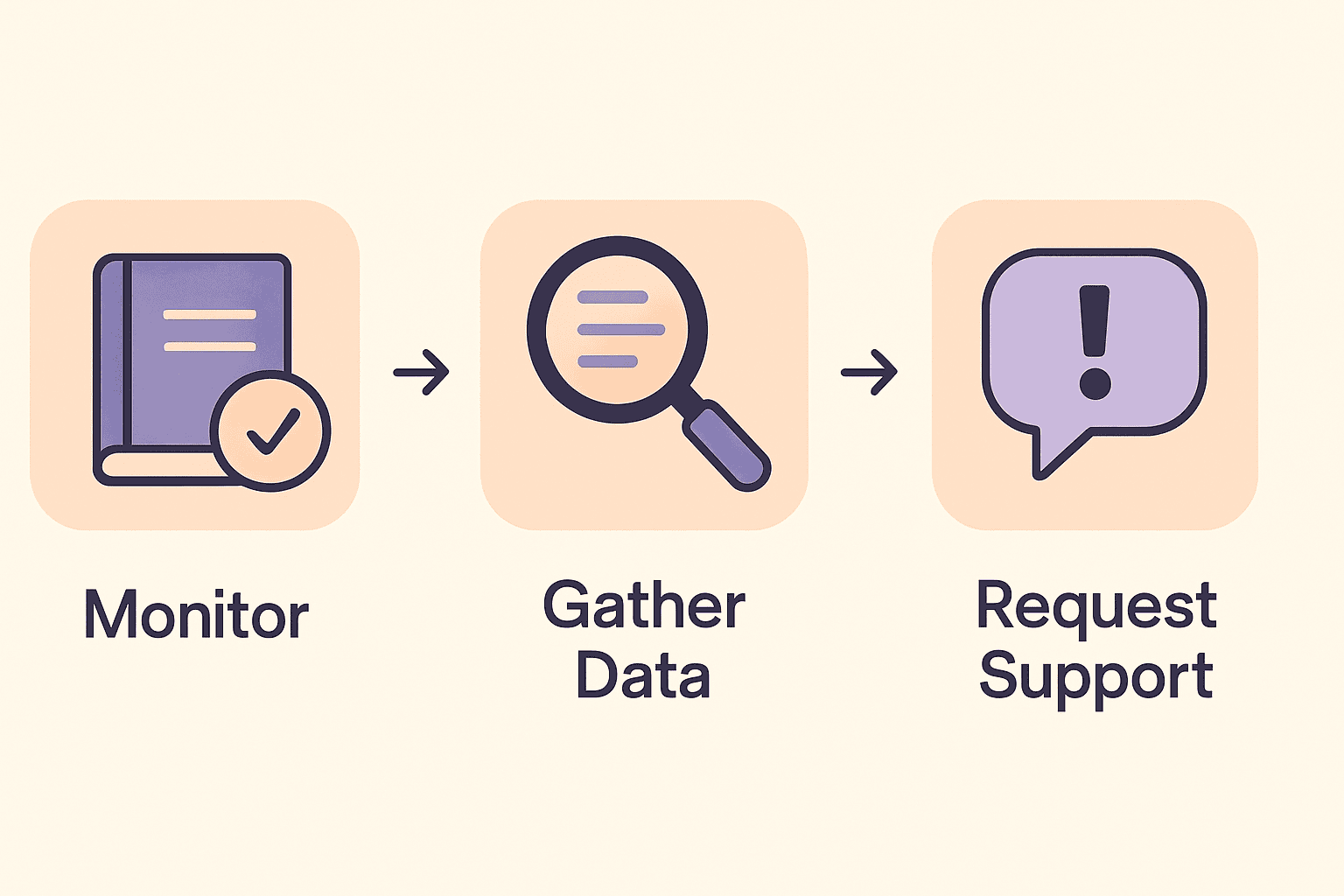
If you suspect your child might be behind in reading, your first move isn’t to hire a tutor or request an evaluation — it’s to collect specific, recent data. Vague worry (“they seem slower than their friends”) won’t get you the help you need. Concrete observation will.
Start by asking the teacher three questions at your next parent-teacher conference: (1) What were my child’s most recent universal screener scores, and what percentile do those represent? (2) Is my child receiving any supplemental small-group instruction, and if so, are they making progress within that tier? (3) Which specific reading skills are emerging on track, and which are lagging? These questions force the conversation past reassurances into evidence.
At home, observe without pressure. Can your child sound out a three-letter word they’ve never seen before, or do they guess based on the first letter? When you read aloud together, can they retell the story in sequence, or do details slip away? Do they avoid reading-related tasks — turning away from books, complaining of stomachaches before reading time, choosing only familiar texts? Avoidance is often an early signal that reading feels hard in a way that’s discouraging, not just challenging.
Write down what you notice across two weeks. Note the book level, the type of task, and your child’s response. Patterns matter more than one-off struggles. If your notes show consistent difficulty with the same skill area (e.g., blending sounds, remembering sight words, staying focused during independent reading), bring those observations to the teacher. Data in hand, you’re equipped to ask: is my child behind in reading in a way that needs intervention, or are we watching and supporting as they develop?
What Schools Will (and Won’t) Do When You Raise the Question
Once you’ve raised the concern, schools typically follow a tiered response model. Understanding what happens at each level helps you know whether your child is getting appropriate support — or whether you need to push harder.
Tier 1: High-quality core instruction for all students. This is the universal curriculum every child receives. If your child is struggling, the first question is whether Tier 1 instruction in your school is aligned with the science of reading — explicit, systematic phonics and phonemic awareness work. If the program is heavily balanced literacy or relies on leveled readers without phonics scaffolding, even typically developing readers may show gaps. You can ask what curriculum the school uses and whether it’s on the recommended list from ParentPowered’s science of reading overview.
Tier 2: Targeted small-group intervention (usually 20-30 minutes, 3-4 times a week). If your child’s screener scores fall below benchmark, many schools will automatically place them in Tier 2 support. This isn’t special education — it’s a more intensive version of the same skills, delivered in a small group with frequent progress monitoring. Tier 2 should be time-limited (6-8 weeks) with clear goals. If your child makes progress and closes the gap, they exit. If they don’t respond after two cycles of Tier 2, the school should either intensify support or begin a different conversation.
Tier 3: Intensive intervention or evaluation for special education. Tier 3 is more frequent (daily), more individualized, and often signals that a child needs something beyond what general education can provide in a small group. At this point, the school may suggest a formal evaluation to determine if your child qualifies for an Individualized Education Program (IEP) under a specific learning disability category. You can also request an evaluation independently at any time if you believe your child needs one; schools are required to respond within a set timeframe (usually 60 days). Our guide on how to request an IEP evaluation walks through the exact process and your rights as a parent.
If the teacher says “let’s give it time” without offering Tier 2 support or a plan to monitor progress, ask explicitly: what will change between now and the next report card, and how will we know if waiting was the right call? Waiting is appropriate when a child is making progress; it’s not appropriate when skills are stagnant and no new instruction is being added. You are allowed to escalate the conversation if you’re not seeing a plan.
The Role of Executive Function and Attention in Reading Struggles
Sometimes the question “is my child behind in reading?” is really masking a different issue: your child has the decoding skills, but can’t sustain attention long enough to practice them, or they lose their place mid-sentence because working memory is overloaded. Reading is a cognitively demanding task, and delays in executive function skills — especially working memory, task initiation, and sustained attention — can make reading feel much harder than it should.
A child who can sound out words in isolation but “forgets” them in context may not have a phonics problem; they may have a working memory issue that prevents them from holding the decoded word in mind long enough to integrate it into the sentence. A child who avoids reading tasks or needs repeated prompting to start may struggle with task initiation, not motivation. These issues don’t show up on a phonics screener, but they absolutely affect reading progress.
If your child’s decoding skills seem intact but reading still isn’t coming together, ask the teacher whether attention, focus, or task persistence might be playing a role. Sometimes the most effective “reading intervention” is actually support for the underlying executive skills that make reading practice possible — breaking tasks into smaller chunks, using timers, building in movement breaks, or teaching self-monitoring strategies. Addressing the cognitive load can unlock progress that direct phonics instruction alone won’t reach.
When you’re trying to answer is my child behind in reading, make sure you’re looking at the whole system — not just the mechanics of decoding, but the cognitive and emotional scaffolding that allows a child to practice, persist, and ultimately become fluent.
Frequently Asked Questions

Lena Carter is a contributing writer for The Daily Well, focusing on practical routines, family systems, and everyday strategies for modern households. With experience managing the demands of a busy home and balancing the realities of modern family life, her work centers on simple, sustainable approaches that reduce stress and create more stability in the day-to-day.
Her writing explores parenting routines, household organization, emotional overwhelm, and the small systems that help families function more smoothly in real life — not just in theory.



