
Child Development in the Real World
There is a version of childhood that runs on neat milestones, predictable phases, and a kid who hits every checkpoint when the chart says they should. Most of us have tried to find our own children inside that version. Most of us have given up somewhere around the morning the eight-year-old refused to put on socks because the seams felt wrong, or the Tuesday the eleven-year-old slammed a door so hard a picture frame fell off the wall and then said you ruined her life over a math worksheet. The Daily Well exists for the space between the milestone-app version of child development and the actual one — the version that accounts for the kid who regresses right before they grow, the friend group that turns over twice in a semester, and the week your normally easy child becomes someone you do not recognize. What follows is a practical map of the developmental frameworks that actually hold. Not because kids are predictable — because the patterns underneath them are.

Child development progresses differently for every child, but emotional support, consistent routines, and age-appropriate expectations can shape how children build confidence, social skills, and independence. Behaviors often change in stages, and what feels challenging today may reflect normal growth tomorrow. The goal is not rushing milestones or creating perfect kids. The goal is understanding development well enough to support children as they grow into themselves.
On This Page
Explore evidence-based strategies for homework and study skills, support for learning differences, guidance on navigating school life, and practical ways to strengthen reading and math at home — so you can advocate for your child and help them thrive academically.


Practical Child Development for Real Life

Modern parenting can feel less like raising a child and more like running daily triage between a milestone tracker pinging at 9 pm, three contradictory pieces of expert advice scrolled past at lunch, and a nine-year-old who has been a different person for three weeks now. Most families are not struggling because they are doing something wrong, or because they missed a stage, or because they failed to find the right framework. They are operating inside an information environment that produces more worry than insight — and a culture that reads every developmental wobble as either a delay or a parenting failure when it is usually neither.
That is why a developmental read matters more than a milestone audit. Kids tend to feel more themselves — and parents tend to make better decisions — when the household understands where the child actually is, what stage they are quietly moving through, and which behaviors are signals rather than problems. From the eight-year-old who suddenly cannot tolerate a haircut to the eleven-year-old who picks a fight before every family event, small reads applied consistently usually produce more clarity than another chart, another book, or another diagnostic worry.
The Daily Well’s Child Development hub focuses on patterns real households can actually use. Instead of milestone-app anxiety or one-size-fits-all advice that ignores temperament, the goal is calmer reads, better conversations with the kid who is changing under your roof, and decisions you can live with at 7:30 pm on a Tuesday — when the homework is still on the table and the dog is barking. These are not perfect-parent fantasies. They are sustainable approaches built around the real friction points of raising a school-age child.

Practical Child Development for Families
Child development works best when it supports real life, not perfection. From calmer reads of difficult behavior to clearer conversations about big feelings and a more honest map of what is normal at each age, our practical frameworks help families understand their kids in ways that hold through normal weeks — not just calm ones.
Explore Child Development
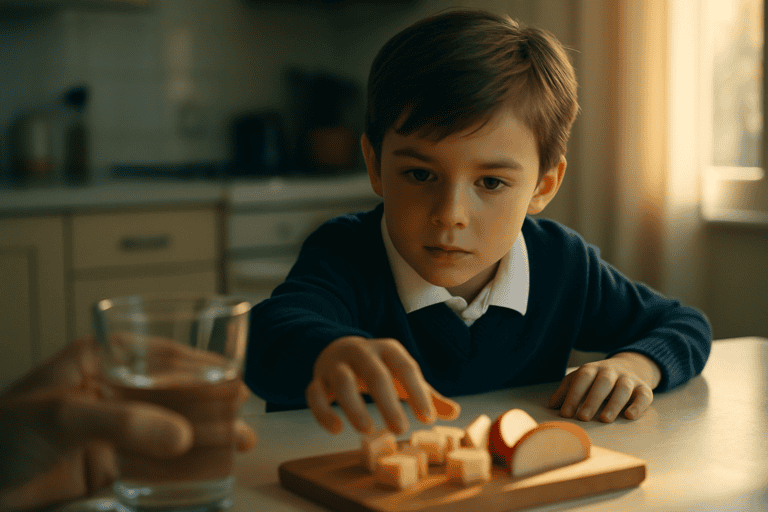
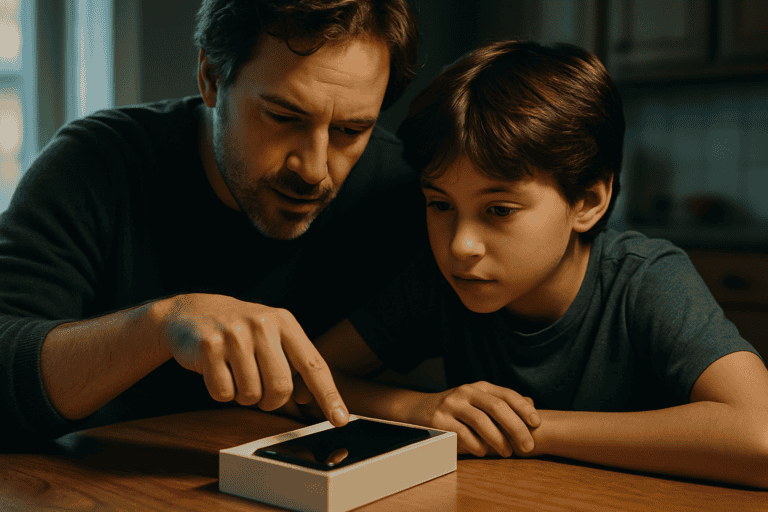
Editorial Snapshot
Today’s Developmental Insight
Most hard behavior is a child trying to say something they do not yet have the words for. Reading the developmental stage underneath the behavior usually changes the response, and the response usually changes the outcome.
Why Kids Regress Right Before a Developmental Leap →
How to recognize disequilibrium in childhood — the messy, often misread phase that usually signals real growth is about to happen.

Why Most Parenting Advice Doesn’t Hold — and What Actually Does
Most parenting advice does not fail because parents are doing something wrong. It fails because it treats children as a category — a generic seven-year-old, a generic preteen, a generic anxious kid — when the kid in front of you is a specific child with a specific temperament moving through a specific stage. The advice that works on one nine-year-old may produce three days of conflict with another nine-year-old in the same grade. The gap is rarely behavioral. It is structural — generic script meets particular kid.
An approach that actually works has to support the real friction points: the homework standoff with a kid who used to love school, the bedtime resistance from a child who has slept easily for years, the friendship blow-up that arrives on a school night. The most effective approaches are rarely the most prescriptive. They are the ones you can apply when you are tired, when the script does not match the moment, and when your kid has executive-function gaps, sensory sensitivities, or simply a developmental rhythm of their own.
Many parents try to overhaul everything at once — a new discipline philosophy, a new emotion-coaching method, a new chart — usually borrowed from a podcast or a carousel. Approaches to navigate child development that survive are usually flexible enough to handle temperament differences and inconsistent co-parenting, and they leave room for neurodivergence — for the real chance that what looks like a stage is an ADHD pattern, a learning difference, or a sensory profile worth understanding. Rigid systems break first; honest, adaptable ones bend without snapping.
Strong child development practice is built around reading the stage and reading the signal, not around fear or correction. Children tend to do better when the adults around them can tell a developmental wobble from a real problem, recognize when a difficult behavior is a child stretching toward something new, and respond to who their kid actually is rather than to who the chart said they would be. Predictable, attuned responses reduce conflict, support cognitive growth, and lower the volume of constant correction that families slip into when development becomes the daily battle.
The goal is not a perfectly developing child — that fantasy belongs to a different parenting era. The goal is calmer reads, better conversations, more honest expectations, and a household that can hold a kid steady through the disequilibrium that always shows up before the next stage arrives
Emotional Regulation
The daily rhythm of a child’s emotional life — the moment a feeling builds, the moment it spills out, the residue that lingers after a meltdown has passed — is where most of the hardest parenting moments actually live. A clear read of what is happening in those moments can lower the temperature of an entire household without changing a single rule. The fight is rarely about the dropped pencil or the wrong cup. It is about a nervous system that has run out of room.
The most useful concept here is Co-regulation — the well-supported idea that children borrow the calm of a regulated adult nearby to manage their own big feelings. Young kids regulate almost entirely through co-regulation; older kids rely on it more than parents realize. Pediatric guidance from the American Academy of Child & Adolescent Psychiatry has been quietly aligned with this for years. Over time, your nervous system tends to matter more than any technique.
Emotion-coaching strategies often break down when parents try to talk a child out of a big feeling that is still running through their body. The “name it, label it, breathe” moves work beautifully on calm days and almost never in the moment they are most needed, because the language part of a child’s brain is offline while a feeling is at full volume. Younger kids need shorter sentences and more physical presence; older kids benefit more from the conversation that happens after. Some kids — especially those with sensory sensitivities or ADHD — flood faster and recover slower, and they need a regulation map built specifically for them. A calm body next to a flooded one usually does more than any script.
Simple Emotional Regulation Ideas
Big feelings are the part of parenting families try to manage first and abandon fastest. The problem is rarely the child’s emotion — it is the Co-regulation Mismatch. When a flooded kid meets an equally flooded adult, two nervous systems escalate each other in real time, and no amount of “use your words” will help until at least one of them resets.
Healthy emotion regulation is less about teaching and more about timing. Even small adjustments — a quiet body next to a loud one, a delayed conversation, a snack before the talk, a walk before the lecture — can lower the temperature of an entire evening. The goal is not a feelings-free home; it is a household where big emotions stop ending in three different injuries.





Behavior & Discipline
Parents tend to evaluate behavior at face value — the lying, the back-talk, the refusal, the meltdown — when the more useful questions sit one layer deeper. What is this behavior trying to communicate? What skill is the child missing? What does the moment right before the behavior look like? A signal-based framework usually beats a correction-based one, because it gives a parent something to teach instead of something to punish.
The most useful concept here is Behavior-as-Signal — the practice of treating difficult behavior as data about a missing skill, an unmet need, or a developmental stage, rather than as the problem itself. Organizations like the Child Mind Institute have shifted their guidance toward looking underneath the behavior — at executive function, emotional capacity, ADHD overlap, and the gap between what a child can do on a good day and what they can sustain on a hard one.
Discipline approaches usually escalate when parents respond to the surface of the behavior rather than the signal underneath. A seven-year-old who lies about homework is rarely a dishonest child — they are usually a kid who has discovered that telling the truth produces a longer conversation than telling a small lie, and adjusted accordingly. A nine-year-old who suddenly refuses things they used to enjoy is rarely defiant; they are a child whose stage has shifted under everyone’s noses. An eleven-year-old who slams doors is rarely disrespectful; they are a kid who does not yet have the language for what just happened to them in seventh-period math. The most useful discipline frameworks do not catalog every misbehavior. They teach you to read the signal, name the missing skill, and decide whether the moment calls for a consequence, a conversation, or a snack.


Simple Behavior & Discipline Ideas
Discipline gets easier when you start from what the behavior is signaling, not from what you have heard about how to respond to it. A behavior that produces three repeat conversations a week is usually a skill gap or a stage shift first — and a discipline issue second. The friction it creates is often a downstream effect of Behavior-as-Signal being missed, not a property of the child.
Healthy discipline is rarely about consequences alone. It is about understanding the function the behavior is performing — what it is getting the child, what it is helping them avoid, what skill it is substituting for — and building responses that teach the missing skill over time. Consequences do some of the work. Teaching does most of it.


Friendships & Social Skills
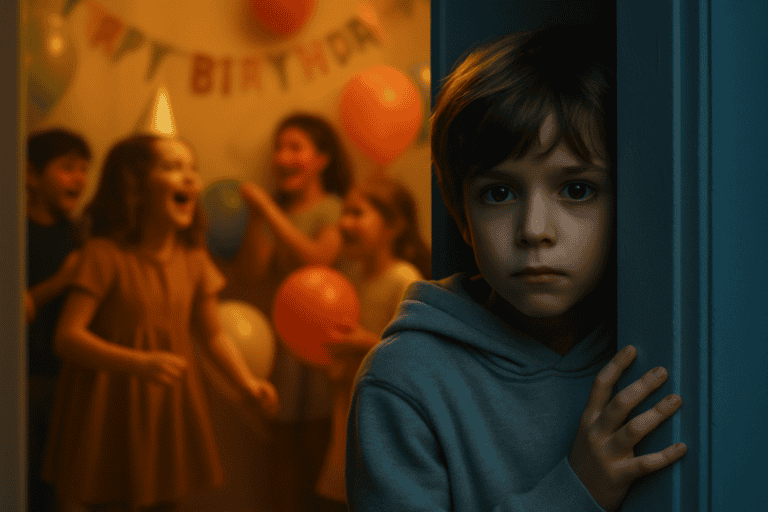
Friendship turbulence works best when parents replace alarm with curiosity. Exclusion, cliques, sibling rivalry, mean-girl dynamics, the slow-motion social re-sorting that happens every fall — all real. But the strongest support is almost never a single intervention. It is a kid who feels safe enough to tell you when something has already gone wrong, paired with a parent who knows enough about social development to respond usefully instead of reactively.
The most useful concept here is the Social Mirror — the process by which school-age kids build their identity by watching how peers respond to them. Friendship drama at ages 8 through 14 often serves this function: kids are not just having drama, they are using other kids’ reactions to figure out who they are. Organizations like the Child Mind Institute and StopBullying.gov have moved toward this kind of frame for a reason.
Social development is rarely a smooth climb — it is a series of re-sortings, and the timing of those re-sortings rarely matches anyone’s emotional bandwidth. The honest readiness signals for navigating peer relationships include the capacity to tolerate disappointment, the ability to read a social cue without a coach in the next room, an emerging sense of one’s own preferences, and a slow-developing tolerance for the fact that being a kid sometimes means being left out. Younger kids need more adult scaffolding around social repair; older kids benefit from being trusted to handle smaller conflicts themselves. The strongest approach supports the process without trying to control the outcome — including for neurodivergent kids, whose social paths often look different from neurotypical peers and benefit from a different kind of support.
Simple Friendships & Social Skills Ideas
The single most useful thing you can do socially is be the person your kid will tell when something has gone sideways. That is harder than it sounds. Kids who expect a parent to call the other kid’s mom, march into the principal’s office, or escalate the situation tend to go silent — and parents who stay calm, curious, and useful tend to keep finding out about things while there is still room to help.
Social-skill conversations work best at low stakes, sideways, and frequently. Talking about how friendships shift, why exclusion happens, what to do when a kid is being unkind, and how to know when something has crossed a line belongs in normal conversation — not in a one-time big talk. Calm repetition outperforms dramatic intervention almost every time.





Developmental Stages
The decisions parents wrestle with most — whether a behavior is a stage or a problem, whether to call the pediatrician or wait it out, whether a regression is a red flag or the very thing that always happens right before a leap — all sit at the intersection of normal and concerning. None of them have a clean answer. They have patterns, and the most useful frameworks help you recognize the pattern instead of pretending every wobble means something dire.
The most useful concept here is Disequilibrium — a developmental phase in which a child temporarily falls apart right before a major leap, growing messier before they grow bigger. Documented for decades in research by Arnold Gesell and the Gesell Institute, the disequilibrium years typically peak around ages six, nine, and twelve. Pediatric guidance summarized by HealthyChildren.org aligns: stages are a map, not a prediction.
The disequilibrium years are notoriously hard. The kid you knew at five is not the kid you have at six; the easy nine-year-old becomes the moody nine-year-old; the cooperative eleven-year-old slams doors over a quiet Sunday. The pattern looks like regression. It is rarely regression — it is the friction of growth, which means it resolves on the other side of a stretch that can last months. Knowing the pattern does not eliminate the difficulty, but it changes the meaning of it. Cognitive growth, executive-function development, and emotional capacity often go through a brief collapse before each leap forward. For neurodivergent kids, the same pattern shows up — sometimes on a different timeline, sometimes more intensely. The most useful frameworks help you recognize what you are inside of and hold steady through the messy middle.


Simple Developmental Stages Advice
Stage reads get easier when you name the pattern out loud. A nine-year-old who has suddenly become impossible is not failing; they are usually inside a disequilibrium year, and most of what looks like regression resolves within a few months. The same pattern often plays out around ages six and twelve — predictable enough that recognizing it tends to lower the volume of a whole household.
Many families also discover that printable systems reduce emotional friction between parents and children. Instead of repeating instructions throughout the day, routines become externalized and easier for everyone to follow consistently. The goal is not to create a rigid household, but to make everyday expectations more visible and predictable.





Practical Tools for Child Development
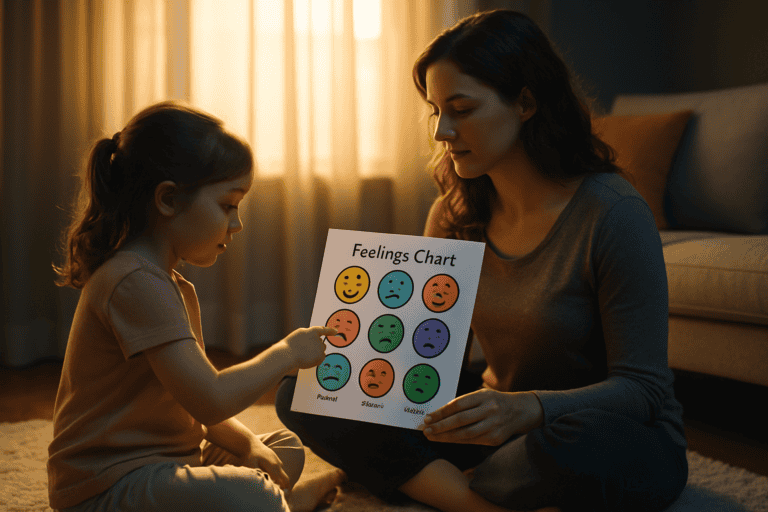
The Daily Well Child Development Toolkit is a fillable reading system for families who need more than another generic milestone tracker to download, ignore, and feel worse about. Inside: a stage-and-disequilibrium reader, the “Name What I Feel” chart for the kid in the middle of a big feeling, a behavior-as-signal decoder, an age-by-age “is this normal” reference for ages 5–15, a friendship-friction reset card, and a quarterly developmental review for noticing the slow child development changes you cannot see from inside the week. It is built to lower the number of panic-Googled questions parents are running at 11 pm.
The Child Development Toolkit lives in the Resource Library alongside several additional planning tools and guides to assist with the daily parenting and wellness journey. New resources are added as built, not on a marketing schedule.
If you would like new practical resources sent directly to you as they are published, you can join the Daily Well list from the same page.
Common Questions About Child Development
These FAQs cover what parents actually type into Google at 11 pm — about regression, anger, big emotions, when to worry, and the difference between a hard phase and a real signal. Plain language, real answers, no panic. If you do not find what you need, the contact page is always open. into boot camp. Together, we can navigate the complexities of child development successfully.
Is my child’s development normal for their age?
Is my 9-year-old’s behavior normal?
Why did my child suddenly regress?
Why is my 12-year-old so angry?
What is normal emotional development by age?
What is disequilibrium in child development?
When should I worry about my child’s behavior?
What’s the difference between defiance and being overwhelmed?
How do I know if my child needs therapy?
What are the stages of child development by age?
Why does my well-behaved kid suddenly act out?
What is the most important thing for school-age kids?
 The Daily Well Parenting Network
Explore More Parenting Guides
The Daily Well parenting network is organized around real family life — routines, digital boundaries, child development, and the systems that make modern parenting feel more manageable.
Family Routines
Practical systems for calmer mornings, smoother evenings, after-school transitions, and family schedules that actually hold.
- Loading recent articles…
Digital Parenting
Realistic guidance for screens, devices, online safety, independence, and raising kids in a connected world.
- More guides will appear here as this section grows.
Child Development
Age-aware parenting support for behavior, emotional growth, independence, communication, and everyday developmental milestones.
- More guides will appear here as this section grows.
Editorial Perspective: The Daily Well is independently published by journalist and mother of two Manila Chan, whose background includes more than two decades in broadcast news and investigative reporting. Our coverage focuses on practical routines, real-world family friction, and research-aware editorial review designed for modern family life — not idealized perfection. All content is human-led and carefully edited for clarity, usefulness, and editorial quality.