Retirement? In your 20s? It might feel light-years away—but that’s exactly why now is the perfect time to start. For couples just starting out, opening a Roth IRA is one of the most powerful (and surprisingly easy) moves you can make for your future.
Even if you’re living paycheck to paycheck, putting a few bucks into a Roth IRA each month now could mean tens—or even hundreds—of thousands later. Here’s why this underrated financial tool should be part of your love story.
What’s a Roth IRA—and Why Should You Care?
A Roth IRA (Individual Retirement Account) lets you invest after-tax dollars now and enjoy tax-free growth and withdrawals in retirement. Unlike a traditional IRA or 401(k), you pay taxes on the money now—but you never pay taxes again on the gains, as long as you follow the rules.
Here’s why that’s gold for young couples:
- You’re likely in a lower tax bracket now than you will be later.
- Time is on your side. Your investments have decades to grow tax-free.
- You can withdraw contributions (not earnings) anytime, penalty-free—which makes it a flexible backup fund.
Want to see the math? Investing just $100/month from age 25 to 35 (then never again) can grow to over $150,000 by retirement, assuming 7% annual returns. That’s compound growth in action.
Can You Open One as a Couple?
Technically, Roth IRAs are individual accounts—each person needs their own. But couples can open matching Roth IRAs side by side, and contribute based on their individual earned income. If one partner isn’t working, the other can contribute on their behalf using a spousal Roth IRA, as long as the couple files taxes jointly.
Some great places to open a beginner-friendly Roth IRA include:
- Fidelity
- Vanguard
- Charles Schwab
- Betterment (for robo-advisor automation)

How Much Can You Contribute—and What If You’re Broke?
For 2025, the annual contribution limit is $6,500 per person (or $7,500 if you’re 50+). But don’t worry if you can’t hit that number. That’s the maximum annual limit, not the minimum. People often conflate the two. Even small, consistent contributions add up.
Start with $25–$100/month and automate it. Over time, as your income grows, so can your deposits.
Pro tip: Set your Roth IRA to pull from a high-yield savings account or dedicated “future you” budget category. You won’t miss what you never see.
Investing: Keep It Simple
Don’t let fear of investing stop you from getting started. Most beginner Roth IRAs offer:
- Target-date funds: Adjusts automatically based on your age
- Index funds: Low-cost, diversified, and historically solid
Stick to well-known funds like VTSAX (Vanguard Total Stock Market Index) or a target-date fund for your expected retirement year (e.g., 2060 if you’re 25 now).
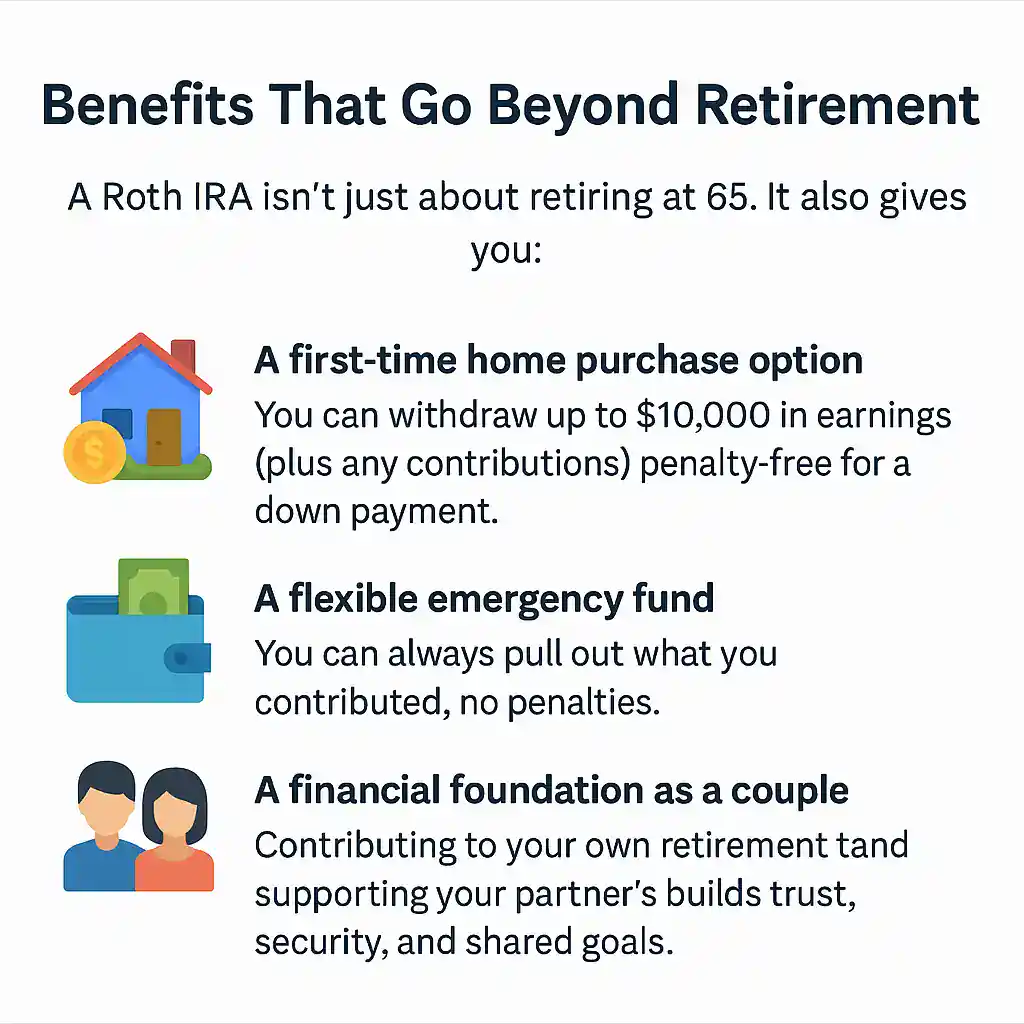
Benefits That Go Beyond Retirement
A Roth IRA isn’t just about retiring at 65. It also gives you:
- A first-time home purchase option: You can withdraw up to $10,000 in earnings (plus any contributions) penalty-free for a down payment.
- A flexible emergency fund: You can always pull out what you contributed, no penalties.
- A financial foundation as a couple: Contributing to your own retirement and supporting your partner’s builds trust, security, and shared goals.
For couples considering their broader financial picture, pairing a Roth IRA with combining finances before marriage or budgeting for two can create a well-rounded approach to money and love.
Bonus: Combine It With Other Smart Habits
Want to build wealth faster? Pair your Roth IRA with:
- A shared budget
- A no-spend challenge to free up cash
- Investing together in generational wealth-building strategies
Final Thought: Start Small, Dream Big
Your 20s are the best time to get in the habit of investing, even if it’s just a little. A Roth IRA is more than a retirement tool—it’s a statement of trust in your future as a couple. You don’t need a ring, a mortgage, or a six-figure salary to get started. You just need $25 and a plan.

Ethan Cole is a contributing writer for The Daily Well covering parenting technology, screen-time culture, family systems, and modern household organization. His background includes graduate work in business and finance, along with experience in operations, consulting, and technology systems architecture.
His work focuses on reducing real-world friction for busy families navigating modern life, with a particular interest in digital overwhelm, technology habits, productivity systems, and the intersection between modern parenting and everyday technology.