
The problem with most printable family routine charts isn’t that they’re poorly designed—it’s that they’re designed to look good on Pinterest, not to function as working systems in your home. After watching hundreds of families attempt to implement routine charts, I’ve come to a counterintuitive conclusion: the chart that actually works is usually simpler, uglier, and more useful than the one that gets saved to your “Parenting Hacks” folder.
This article examines routine charts as household systems rather than decorative tools. If you’re building a broader family routines framework, charts serve as visual interfaces for habits you’ve already established—not as magic solutions that create routines from scratch. The difference matters more than most parenting articles acknowledge.
Why Printable Routine Charts Fail After Three Days
Most families experience the same pattern: enthusiastic printing and laminating on Sunday evening, dutiful checking on Monday and Tuesday, sporadic use on Wednesday, and complete abandonment by Thursday afternoon. The chart remains mounted on the refrigerator for six weeks as a silent monument to good intentions.
The failure happens at a systems level, not a motivation level. Research from the American Psychological Association on habit formation in children shows that visual cues work only when three conditions align: the child understands what action to take, possesses the capability to complete it independently, and receives immediate feedback on completion. Most printable charts address only the first condition.
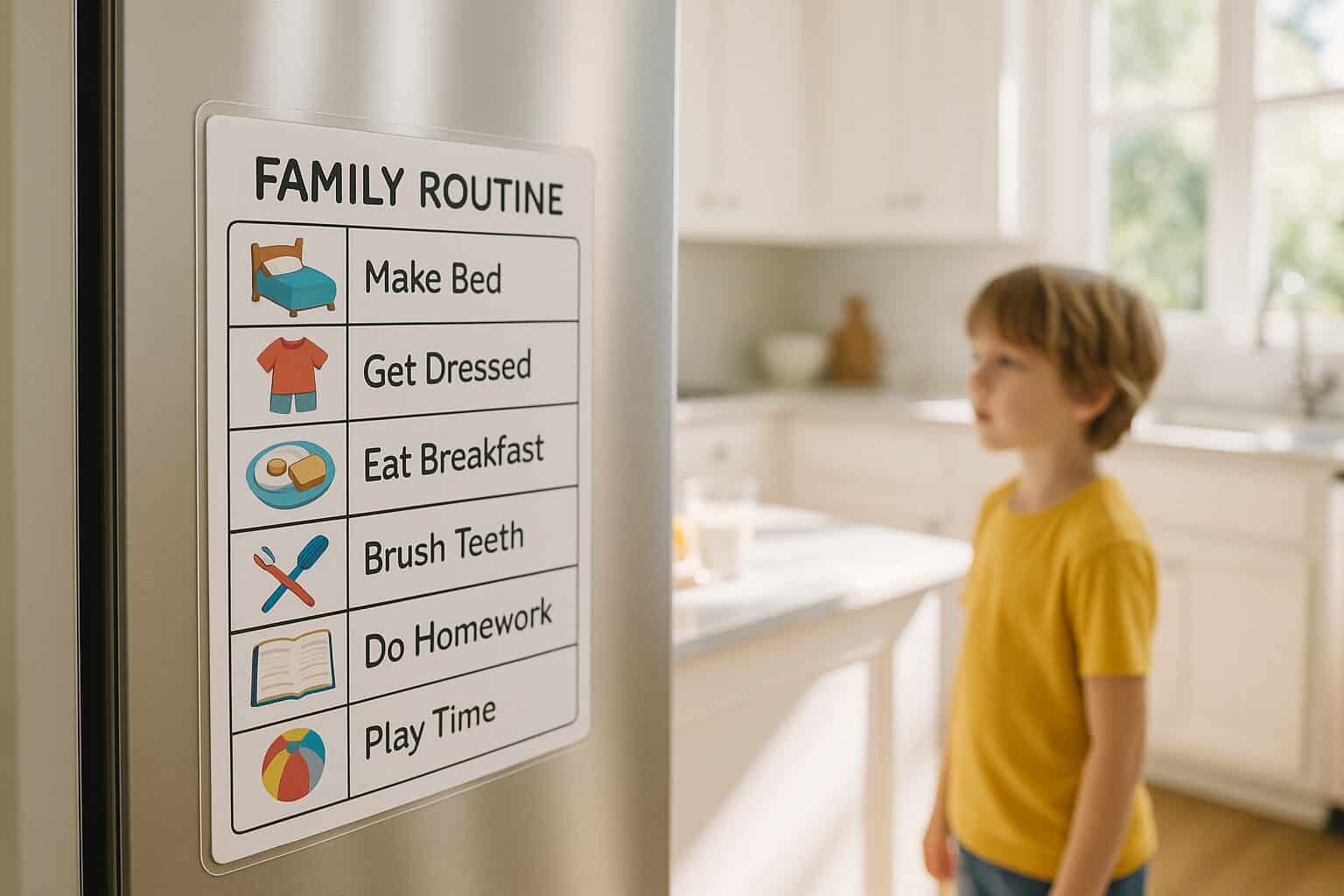
Beautiful charts fail because they optimize for aesthetic appeal rather than functional clarity. A chart with illustrated icons for “brush teeth” and “make bed” looks lovely but doesn’t tell a six-year-old when to check it, how to mark completion, or what happens if a task gets skipped. The chart functions as decoration, not as a system.
The other fundamental problem: most routine charts confuse several different tools. A morning routine chart serves different purposes than a chore chart, which differs from a family schedule chart, which differs from a command center. Using a single visual tool to accomplish multiple functions guarantees that it accomplishes none of them well.
The 4-Box Family Routine Chart System
Effective routine charts function as decision-support tools, not tracking tools. The chart shouldn’t tell your child what to do—it should help them remember what they already know how to do. This distinction reshapes how you design the chart itself.
The framework I’ve seen work consistently divides any routine into four visible elements:
Box 1: What happens first. Children need a clear entry point. Not “morning routine” but “after you wake up, come downstairs and check this chart.” The sequence matters more than the comprehensiveness. One clear starting action beats six simultaneous tasks.
Box 2: What the child owns. These are tasks your child can complete independently without reminders, help, or quality checks from you. For a four-year-old, this might only be “put pajamas in hamper.” For a ten-year-old, it might include showering, dressing, and packing their backpack. The list should match actual capability, not aspirational capability.
Box 3: What the parent still supports. These tasks require your presence, help, or verification. For younger children: applying sunscreen, checking homework folders, supervising toothbrushing. For older children: reviewing the day’s schedule, discussing any problems, handling permission slips. This box prevents the chart from becoming a fantasy of independence that doesn’t match your family’s reality.
Box 4: What counts as done. Define completion clearly. “Room clean” means nothing. “Bed made, floor clear, hamper closed” creates an observable standard. This eliminates the negotiation loop that derails routines more than forgotten tasks do.
This four-box structure works because it separates sequence (Box 1), autonomy (Box 2), collaboration (Box 3), and standards (Box 4). Most printable charts jumble these elements together, creating confusion about what the child should do without being told.
How Visual Routine Charts Actually Build Executive Function
Routine charts work through a mechanism more specific than “teaching responsibility.” According to Harvard Health research on executive function development, visual systems externalize working memory—the mental capacity children use to hold multiple steps in mind while completing tasks.
When a seven-year-old references a chart instead of asking “What do I do next?”, they’re practicing the cognitive skill of consulting external supports rather than relying solely on internal memory or parental prompting. This matters because executive function develops through practice with structured support, not through independence demanded before capability exists.
The chart itself becomes a transitional tool. Children begin by checking it constantly, then occasionally, then rarely, until the routine becomes automatic. At that point, the chart has succeeded by making itself obsolete—but only because it was designed as a teaching tool rather than a permanent management system.
This is why the “uglier” chart often works better: children can write on it, modify it, and eventually discard it without losing a beautifully designed artifact. The chart should be disposable, not precious.
Morning Routine Charts That Function as Systems
Morning routines require the tightest systems because they operate under time pressure and parental stress. A functional morning routine for school days depends on reducing decisions, not increasing tasks to check off.
For younger children (ages 4-7), effective morning routine charts contain no more than five items, presented in strict sequence with visual cues. The chart should hang exactly where the child starts their morning—not in their bedroom where they can ignore it, but in the location they naturally arrive after waking.
Morning Routine Chart for Children Ages 4-7
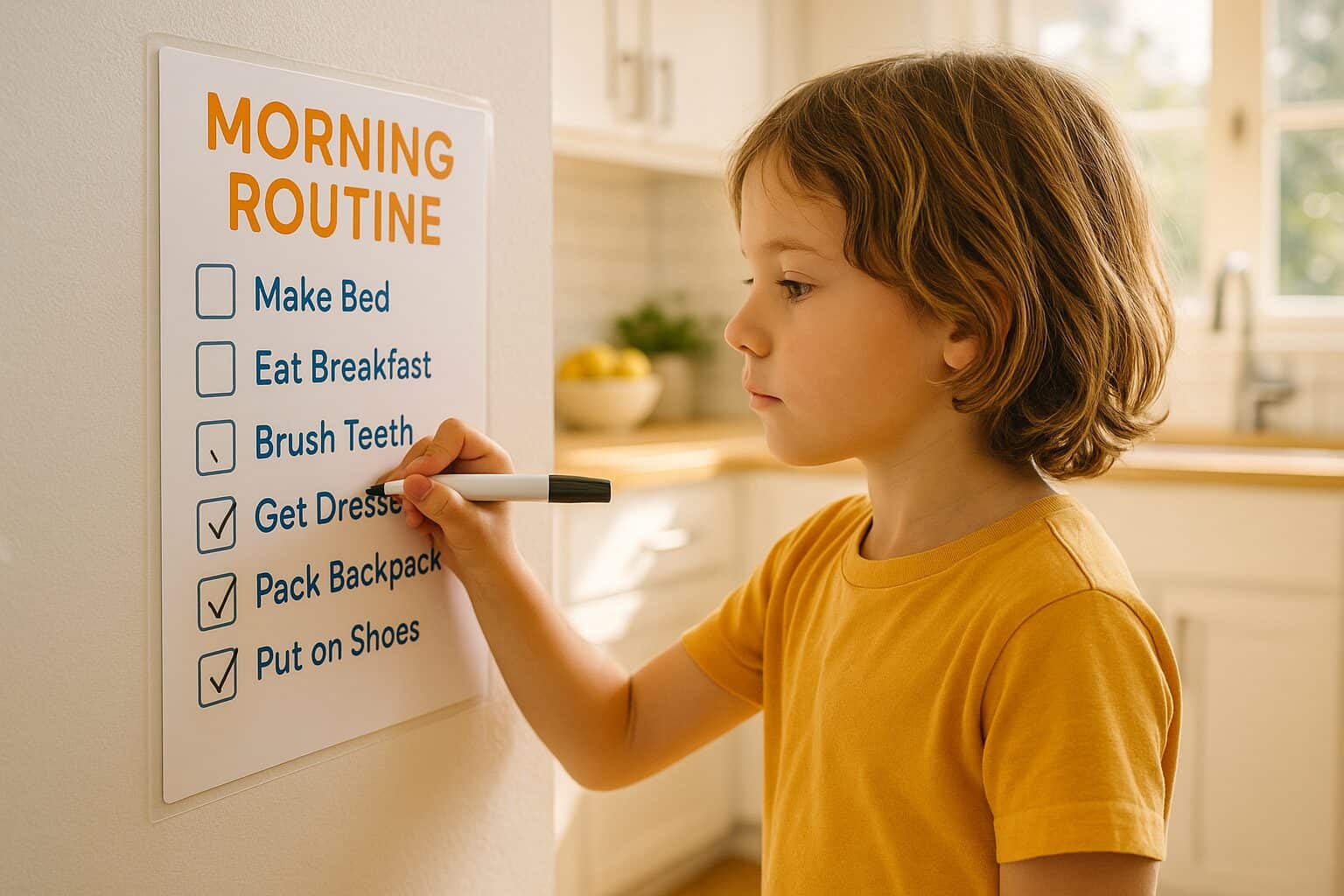
The age 4-7 chart should focus exclusively on personal care tasks that happen in sequence: bathroom, get dressed, breakfast, brush teeth, shoes and backpack. Each item represents one complete action. “Get dressed” is sufficiently specific for this age; “put on underwear, put on shirt, put on pants, put on socks” is excessive detail that fragments the task.
For older children (ages 8-12), morning routine charts shift toward time awareness rather than task sequencing. The chart shows what must be completed by specific times: “7:15 – dressed and downstairs / 7:30 – breakfast finished / 7:40 – backpack and shoes ready.” This format acknowledges that older children can manage their own task sequencing but still need help with time management.
Morning Routine Chart for Children Ages 8-12
The most common error in school morning routines for families is creating a chart that treats all children the same age identically. Your child’s actual capability should determine the chart design, not their grade level. Some eight-year-olds need visual sequencing; others need time targets. The chart should match the child’s developmental needs, not generic age expectations.
Building independent morning habits for kids means removing tasks from the chart as they become automatic, not adding more tasks to make the chart “complete.” A chart that shrinks over time signals success.
Designing Printable Family Routine Charts for Different Daily Segments
Each time segment in a family’s day requires different chart architecture because the underlying system serves different purposes.
After-school routines need transition support more than task support. Children arrive home depleted, dysregulated, and often hungry. The after-school routine chart shouldn’t list tasks—it should offer choices within structure: “Choose: outside time or quiet time in your room / Then: snack at kitchen table / Then: check this chart for homework routine.”
After-School Homework Routine Chart
A homework routine chart functions differently than other routine charts because homework varies daily in type and duration. Rather than listing specific tasks, effective homework charts define the system: where homework happens, what materials need to be gathered first, how to signal when help is needed, what happens when homework is complete. The chart supports the routine around homework, not the homework itself.
Bedtime routines require countdown awareness. Children need to see how much time remains before bed, not just what tasks to complete. A bedtime routine chart works best as a visual timeline: “7:30 – start getting ready / 7:45 – pajamas and teeth done / 8:00 – books and talking time / 8:20 – lights out.” The time markers prevent the endless negotiation of “just five more minutes” because the system is visible and agreed upon.
TDW Bedtime Routine Chart
The Critical Difference: Routine Chart vs. Chore Chart vs. Schedule vs. Command Center
Families often fail with printable charts because they’re using the wrong tool for their actual need. These are four distinct systems:
A routine chart supports habit execution. It shows the sequence of recurring tasks that happen the same way each day: morning preparation, bedtime sequence, after-school transition. The routine chart answers “what do I do next in this familiar pattern?”
A chore chart distributes responsibilities across family members. It shows who does what and when completion is expected. A chore chart for kids answers “what is my job this week?” Unlike routine charts, chore charts can rotate, reassign tasks, and track completion over longer periods.
Weekly Family Chore Chart
A family schedule chart coordinates timing across the household. It shows who needs to be where at what time: “Tuesday – Emma soccer 4pm, Jake piano 5pm, Mom late meeting.” The schedule chart prevents conflicts and ensures transportation logistics work. It answers “what’s happening today for everyone?”
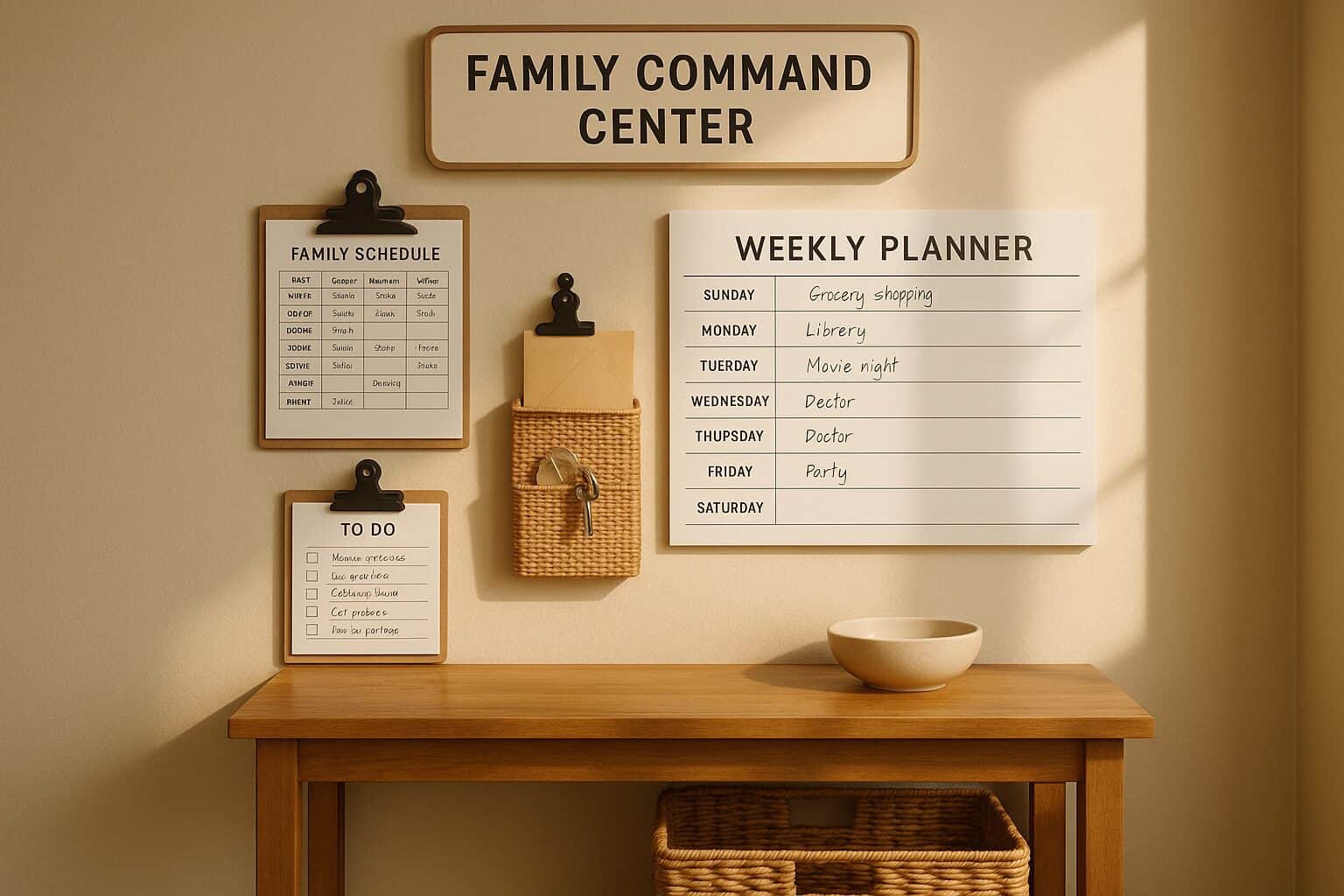
A family command center functions as an information hub, not an action tool. It holds permission slips, emergency contacts, the family calendar, meal plans, and temporary notes. Command centers organize information; routine charts organize behavior.
Most families need elements of several tools, but confusing them creates dysfunctional hybrids. A morning routine chart cluttered with soccer schedule reminders and whose-turn-to-feed-the-dog tracking fails at all three purposes. Keep the tools separate and let each serve its specific function.
Building Printable Family Routine Charts That Adapt as Systems
The best routine chart contains built-in obsolescence. It should be designed to change, not to remain static for months. This is why highly designed, expensively printed charts often fail—they’re too precious to modify when the system needs adjustment.
When building a family routines operating system, charts serve as user interfaces for deeper behavioral systems. The chart displays what the family has already agreed to do, has practiced together, and has verified actually works. It doesn’t create the routine—it supports the routine that already exists.
This is why I recommend starting with the ugliest possible chart: a handwritten index card taped to the bathroom mirror. Run the routine manually for a week. Note what gets forgotten, what causes confusion, what prompts questions. Revise the card based on actual usage. Only after the system works consistently should you consider creating a nicer chart.
When families skip this testing phase and jump directly to laminated perfection, they build beautiful interfaces for routines that don’t function. The chart looks wonderful and accomplishes nothing. Understanding why family routines fail reveals that most failures happen at the design stage, not the implementation stage.
The Three-Week Testing Protocol for Any Routine Chart
Week 1: Parent and child complete the routine together while consulting the chart. The parent does most tasks while narrating them. The chart serves as a reference script, not as an independent tool. Note which items confuse the child or require repeated explanation.
Week 2: Child leads the routine while parent observes and provides minimal prompting. The child checks the chart themselves but asks for help as needed. Note which transitions between tasks cause delays or resistance. Notice whether the chart’s physical location works or needs adjustment.
Week 3: Child completes routine independently. Parent verifies completion at the end but doesn’t supervise individual steps. Note whether the “what counts as done” definitions actually work or need refinement. This is when you discover whether “clean room” needs to become “bed made, floor clear, hamper closed.”
Only after this three-week protocol should you invest time in a polished version of the chart. The version that emerges from testing will differ significantly from your original design—and that’s exactly why testing matters. The goal isn’t a pretty chart; the goal is a functional system.
Visual Design Elements That Actually Matter in Printable Routine Charts
When visual design serves function rather than decoration, certain elements prove consistently effective:
Sequence numbers or arrows. Make the order unmistakably clear. “1-2-3” works better than “morning tasks” as a category heading. Children shouldn’t need to infer sequence from spatial layout.
Completion marking that’s immediate and satisfying. Checkboxes work. Magnets that move from “to do” to “done” work. Stars that get placed work. Digital apps that require parent login to mark completion don’t work for young children. The feedback loop must be instant and child-controlled.
Visual cues that match the child’s literacy level. For pre-readers, photographs of your actual child performing each task work better than generic illustrations. For emerging readers, the word “teeth” paired with a toothbrush image provides more support than the word alone. For fluent readers, words suffice and too many pictures become condescending.
Physical location that intercepts the routine. The chart must exist where the child naturally sees it while performing the routine. A morning routine chart belongs in the bathroom or kitchen, not the child’s bedroom. An after-school chart belongs by whichever door the child enters. A bedtime chart belongs in the child’s room or bathroom.
What doesn’t matter: color coordination with your kitchen decor, expensive lamination, elaborate borders, or professionally illustrated icons. These elements serve parent preferences, not child functionality. The chart your child actually uses will likely accumulate smudges, marks, and modifications—all signs that it’s functioning as a working tool rather than decorative art.
When to Use Printable Family Routine Charts vs. Other Systems
Routine charts work best for specific situations, and work poorly as universal solutions. Use printed charts when:
The routine is consistent across days. Morning and bedtime routines rarely vary, making them ideal for printed charts. After-school routines that differ Monday through Friday need different tools—possibly a weekly schedule rather than a daily routine chart.
The child is old enough to reference visual information independently. Generally ages 3-12. Younger toddlers lack the impulse control to consult charts without prompting. Teenagers often resist visible charts as babyish, preferring phone reminders or written lists they create themselves.
The parent is available for initial support but wants to reduce verbal reminding. Charts don’t eliminate parental involvement—they shift it from constant prompting to occasional check-ins. If you’re present anyway, verbal guidance often works better than chart-checking for very young children.
Don’t use routine charts when the routine is still being established. Charts support habits that already exist; they don’t create habits from scratch. If your child doesn’t yet know how to complete the tasks or doesn’t see them as normal expectations, the chart becomes just another thing to ignore.
Similarly, don’t use routine charts during high-stress periods or major transitions. When a family is handling a move, new baby, divorce, or other disruption, routines need to be simplified to essential basics—usually managed through direct interaction rather than charts. You can reintroduce charts once the new normal stabilizes.
Making Printable Routine Charts Work Within Your Household System
The chart is never the system—it’s an interface to the system. The actual system includes agreed-upon expectations, practiced behaviors, parental consistency, and consequences for completion or incompletion. The chart makes this underlying system visible and consultable.
This means several elements must exist before the chart can function:
The child must have demonstrated capability to complete each task. Not perfectly, but independently. If your child cannot brush their teeth without assistance, putting “brush teeth” on a routine chart doesn’t teach the skill—it creates a point of failure in the routine.
The family must have discussed and agreed on standards. “Room clean” means the same thing Monday through Sunday, not different things based on parental mood. This agreement happens in conversation, preferably during a weekly family meeting, not by creating a chart and hoping everyone interprets it identically.
The parent must commit to checking completion and providing feedback. A chart without follow-through becomes decorative. For the first several weeks, you’ll need to verify that tasks were completed to standard, acknowledge success, and address shortcuts or skipped items. This isn’t micromanagement—it’s system maintenance.
The household must have a plan for handling chart failures. What happens when a child skips items, rushes through without meeting standards, or simply ignores the chart? The consequence should be logical and immediate: natural consequences work better than elaborate reward systems. If the morning routine doesn’t get completed, the child goes to school without breakfast or leaves wearing yesterday’s clothes. The chart shows expectations; reality provides feedback.
The Long View: What Printable Routine Charts Teach Beyond Task Completion
Functional routine charts teach children to use external systems to support internal organization—a meta-skill more valuable than any specific routine. The child who learns to check a chart, follow a sequence, and evaluate their own completion is practicing executive function skills that transfer far beyond household chores.
This learning happens through properly designed tools that match the child’s developmental stage and actual capability. It doesn’t happen through aspirational charts that display what you wish your child could do independently. The gap between the chart’s expectations and the child’s capability creates only frustration and failure.
Over time, children internalize the routines the chart supports. They stop checking the chart because the sequence has become automatic. This is success—the chart has served its purpose as a transitional tool. At that point, you might remove the chart entirely or shift it to support a different emerging routine.
The families who successfully use routine charts understand them as temporary scaffolding, not permanent fixtures. The goal isn’t a child who depends on charts forever; it’s a child who learns to build and follow routines with decreasing external support. The chart is the training wheels, not the bicycle.
This perspective transforms how you approach printable routine charts. You’re not searching for the perfect chart that will solve all organizational challenges. You’re selecting or creating a functional tool that supports current learning while remaining disposable enough to modify or discard as your child’s capability grows. Simpler, uglier, and more useful beats beautiful and static every time.
Frequently Asked Questions

The Daily Well Team creates practical, research-backed content focused on modern parenting advice, wellness tips for moms, and everyday strategies for real families. We cover routines, child development, family systems, and smart lifestyle solutions that help busy households reduce stress and function more effectively. Our editorial approach is grounded in clarity, simplicity, and real-world results.



