
If your family’s spending habits feel chaotic or cluttered, you’re not alone. Between surprise toy purchases, kitchen gadgets you swear you’ll use, and wardrobe refreshes for growing kids, costs pile up—fast. Enter a powerful yet simple mindset shift: the One-In, One-Out Rule for family spending.
This minimalist budgeting hack, which originated in the world of capsule wardrobes and decluttering, is now being used by families to build financial discipline, reduce waste, and teach kids smart money habits. And yes—it actually works.
What Is the One-In, One-Out Rule for Family Spending?
At its core, the One-In, One-Out Rule is exactly what it sounds like: whenever something new comes into your home—whether it’s a toy, an appliance, or even a streaming subscription—something else must go. The “out” doesn’t have to be the same category, but it must balance the scale in terms of cost, space, or value.
Applied to family spending, it encourages intentional purchases and helps reduce impulse buys, especially when it comes to children and household goods. The result? A cleaner home, clearer mind, and healthier bank account.
Why the Rule Works for Family Budgets
Minimalist budgeting works because it replaces guilt-based savings tactics with clear boundaries. Instead of asking “Can we afford this?” families begin asking “What are we willing to give up for this?” It transforms spending into a value-based decision.

According to a recent report by the National Endowment for Financial Education (NEFE), families that use behavioral budgeting methods—like envelope systems or spending swaps—tend to reduce debt and increase savings more effectively than those that rely solely on budgeting apps.
By framing purchases as trades, not additions, the One-In, One-Out Rule slows down consumption and puts your family’s core values front and center.
Teaching Kids Intentional Spending Early
This method is especially effective with kids. Instead of constantly saying “no,” parents can say “yes—but what are you willing to swap?”
For example, a child wants a new toy? Great! But they must choose one toy to donate or sell. This empowers kids to weigh their choices, develop a sense of value, and embrace delayed gratification—an essential financial skill.
The nonprofit Jump$tart Coalition for Financial Literacy recommends starting money conversations with children as young as five, and this rule creates the perfect framework.
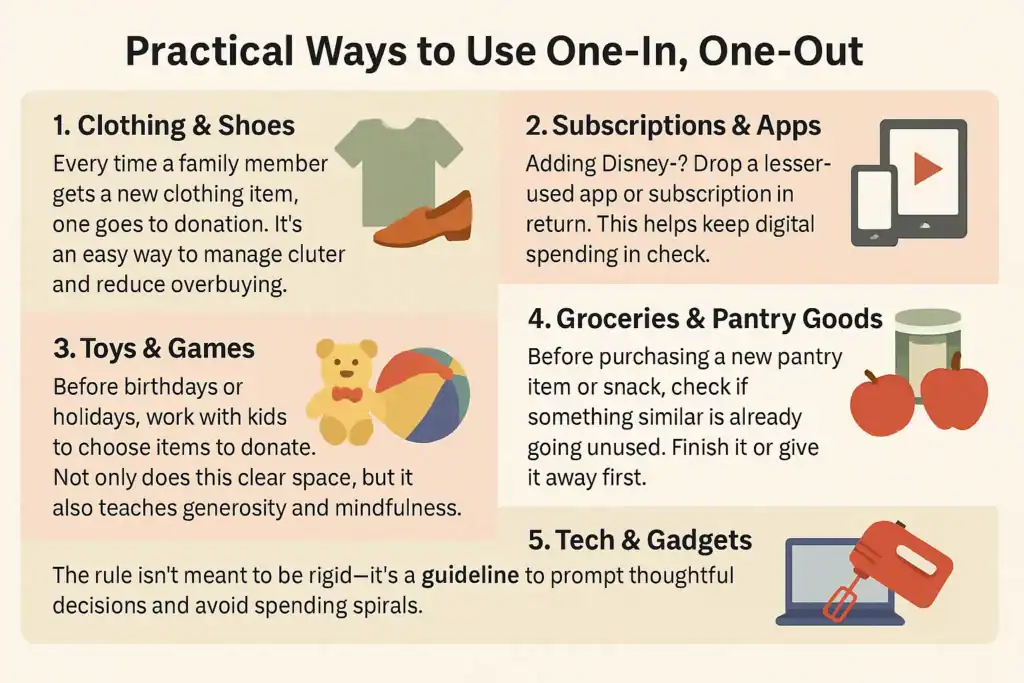
Practical Ways to Use One-In, One-Out
1. Clothing & Shoes:
Every time a family member gets a new clothing item, one goes to donation. It’s an easy way to manage clutter and reduce overbuying.
2. Subscriptions & Apps:
Adding Disney+? Drop a lesser-used app or subscription in return. This helps keep digital spending in check.
3. Toys & Games:
Before birthdays or holidays, work with kids to choose items to donate. Not only does this clear space, but it also teaches generosity and mindfulness.
4. Groceries & Pantry Goods:
Before purchasing a new pantry item or snack, check if something similar is already going unused. Finish it or give it away first.
5. Tech & Gadgets:
Thinking of buying a new device or kitchen tool? Sell or donate one you haven’t used in six months.
The rule isn’t meant to be rigid—it’s a guideline to prompt thoughtful decisions and avoid spending spirals.
One-In, One-Out for Non-Material Items
Here’s the fun part: the rule can apply to more than stuff. Use it for time, habits, and energy too.
For example, if you commit to a new weekend activity, maybe you scale back another time commitment. If you add a new family tradition, maybe another one can evolve or sunset. Less clutter—whether physical or emotional—equals more breathing room.
The Emotional Benefit: Less Clutter, More Clarity
In a study published by The Journal of Consumer Psychology, clutter was directly linked to feelings of anxiety and dissatisfaction in the home. Meanwhile, minimalism is associated with increased focus and contentment.
So while you’re saving money, you’re also creating space—mentally and physically—for what matters most. And that’s something no budgeting app can automate.
How to Get Started Today
If your family wants to try the One-In, One-Out Rule, start small:
- Set a trial period: Try the rule for one week.
- Choose categories: Start with toys or clothing—where clutter is most visible.
- Get the kids involved: Turn it into a game. For each item “in,” ask: what goes “out”?
- Track your wins: Keep a log or photo album of swaps. It’s satisfying to see your progress.
- Celebrate the mindset: Reward yourselves with experiences, not stuff.
Over time, this becomes second nature—and you’ll be amazed how it transforms your family’s relationship with spending

Ethan Cole is a contributing writer for The Daily Well covering parenting technology, screen-time culture, family systems, and modern household organization. His background includes graduate work in business and finance, along with experience in operations, consulting, and technology systems architecture.
His work focuses on reducing real-world friction for busy families navigating modern life, with a particular interest in digital overwhelm, technology habits, productivity systems, and the intersection between modern parenting and everyday technology.


